
- SEO Agency for Architects
Premium SEO Services for Architects: Rank Higher, Win the Right Projects
Great design doesn’t rank itself. Right SEO ranks it.
Who are we? What do we do?
Quick Answer: Sorted ROI is an SEO agency for architects that want real project inquiries through higher organic rankings. Our SEO services for architects cover technical fixes, organic search, content, and authority building and our every recommendation is based on one thing: To bring you the residential, commercial, or institutional clients you want.
- Architects SEO Services
Sorted ROI’s SEO Services for Architects Include
Quick Answer: Our SEO services for architects cover nine pillars — keyword research, technical SEO, on-page and content, portfolio and project-page SEO, topical authority, off-page SEO, Generative AI search, and transparent reporting.
Nothing is templated, everything is specialized to you, your service area, and the projects you want to win.
We use bespoke SEO strategies for every client because a residential-only studio and a multi-office architectural firm don’t need the same strategy, so they don’t get the same one.
We are the architects of consumer acquisition, and as your SEO agency for architects, here’s what we bring to the table:
Keyword Research & Competitive Positioning

We don’t just target “architect.” We map service, location, and project type like “custom home architect” in your top service areas, “commercial architect” for your target industries, “sustainable architecture firm”.
- Long-tail, high-intent keywords over broad, low-converting ones
- Analysis of who’s already ranking, and where the gaps are
- Keywords weighed by what a client is actually worth to you, and not just search volume
Because a keyword with low monthly volume but a client worth $150K deserves more of your strategy than a high-volume one tied to work you don’t even want.
Technical SEO for Architecture Websites

This is the foundation every other pillar depends on.
- 4K Render and portfolio image compression, without sacrificing visual quality
- Core Web Vitals, mobile performance, and crawlability
- Clean site architecture so both Google and visitors can find what they need in seconds
- Schema markup so search engines understand exactly what your firm does and where
Architecture sites carry more visual weight than almost any other industry’s website. That makes this pillar do more heavy lifting here than it typically does anywhere else.
On-Page & Service-Page SEO

Most architecture sites have one page trying to represent six services. That page ranks for none of them.
- Dedicated service pages per typology like residential, commercial, institutional, sustainable, instead of one page doing everyone’s job
- Title tags, headers, and meta descriptions built around real search terms
- Internal linking that guides both visitors and search engines through your site logically
A firm offering both custom residential design and commercial fit-outs needs two distinct pages, each written for the client actually searching for that service.
Portfolio & Project-Page SEO

Your projects are your best sales tool. Most firms let them sit in an unoptimized gallery.
- Every project turned into a keyword-mapped page and not just images, but the story: the brief, the challenge, the solution, and the result
- CreativeWork schema on individual projects, so search engines and AI tools can understand and show them
- Descriptive, keyword-rich alt text on every image, so your work can be found through Google Images too
A single well-built project page can rank on its own for “modern lakeside home architect,” pull in visitors who never knew your firm’s name, and still sell just as hard as your homepage does.
Content & Topical Authority

The content that ranks best isn’t a design-trends blog. It’s the answer to what a client actually wants to know before they call.
- Budget guides, timeline breakdowns, permitting basics; the questions every prospective client is quietly Googling
- Content clustered around your real specialties, and building topical authority Google can’t ignore
- Written to answer clearly in the first few sentences; good for a skimming reader, and for getting cited by AI search tools
A page titled “How Much Does a Custom Home Architect Cost in [City]” will often out-convert a beautifully written essay on design philosophy, because it meets a real client at the exact question they’re asking.
Off-Page SEO, Digital PR & Link Building

On-page SEO tells Google what your site is about. Off-page SEO tells Google and AI tools whether to trust it.
- Earn coverage from design and architecture publications
- Listings in industry directories: the AIA directory, Houzz, Archello, and relevant regional associations
- Award submissions and press outreach that double as high-quality backlinks
- Partnerships with contractors, interior designers, and real estate developers for natural, relevant cross-links
For a licensed profession like architecture, these signals do double duty — they help you rank, and they reassure a client who’s about to hand you a six- or seven-figure project that you’re the real thing.
AI Search & GEO for Architecture Firms

Someone asks ChatGPT or Google’s AI Overview “who’s a good [specialty] architect in [city]” and gets a direct answer, sometimes with no click to any website at all.
We structure your content and schema markup so your firm has a real shot at being that answer.
100% Transparent Report for Firm Principals

You’ll see rankings, traffic, and, more importantly, qualified inquiries traced back to the specific page and keyword that produced them.
No jargon. No 40-page PDF you open once and never again.
Local SEO for Architects

Local SEO for architects is how your firm wins the map pack; the three local results Google shows above everything else for searches like “architect near me.” For most firms, this single piece of the strategy produces the fastest visible results of the entire plan.
01

Google Business Profile Optimization for Architecture Firms
Your Google Business Profile is often the first impression a potential client gets of your firm, before they ever open your website.
- The right primary and secondary categories (Architect, Architectural Designer, and any relevant specialty)
- Complete service lists, business hours, and high-quality photos of both projects and your office
- Regular posts and an actively managed Q&A section to actively send expertise signals to Google
According to the latest report on Google Business Profile, website visits drive 47% of all Google Business Profile engagement, direction requests account for 38%, and phone calls make up the remaining 15%.
This means an incomplete or neglected profile is quietly costing you all three.
02

Service-Area & City Pages for Multi-Office Firms
If you serve more than one city or region, one generic “About” page can’t rank for all of them.
- A dedicated page per office or service area, each genuinely useful and not a copy-paste template with the city name swapped
- Location-specific proof: local project examples, local press, local credentials
Done well, this is also how a growing firm quietly out-ranks bigger, better-known competitors who never bothered building a page for each market they claim to serve.
03

Citations, NAP Consistency & Industry Directories
Your Name, Address, and Phone number (NAP) need to match, exactly, everywhere your firm is listed.
- Consistent listings across the AIA directory, Houzz, Archello, Dwell, and local chambers of commerce
- Regular audits to catch and fix outdated or duplicate listings because a small inconsistency here can quietly undercut everything else
Google cross-checks these listings against each other as a trust signal. A firm with matching, complete citations across a dozen directories reads as established.
A firm with three conflicting addresses reads as unreliable, even if the actual work is better.
04

Reviews & Reputation Management
Number of reviews and their recency influence local rankings and also influence a potential client’s decision long before they call.
- A real, repeatable system for asking satisfied clients to leave a review, built into your project close-out process rather than left to memory
- Thoughtful responses to every review, good or bad as it shows future clients you’re paying attention
A profile with ten recent and detailed reviews will consistently outperform the one with fifty reviews that stopped coming in three years ago.
05

Local Link Building
- Local press coverage and community sponsorships
- Mentions from local business associations and chambers of commerce
- Cross-links with local contractors, interior designers, and real estate professionals you already work alongside
These links do double duty: they help your local rankings, and they come from exactly the kind of relationships that also generate referrals.
- Architects SEO Services by Forte
SEO for Architecture Firms of Every Size and Specialty
Whether you’re a solo architect or a multi-office firm, whether you build custom homes or campus master plans, SEO for architect firms works the same way in principle and completely differently in execution. Our strategy matches your firm.
Solo Architects & Boutique Studios

We focus on lean, high-intent, hyper-local because every dollar has to work harder, and every ranking matters more. The strategy usually leans hardest on local SEO and a handful of tightly targeted service pages, rather than a broad content library that takes months to build out.
Mid-Size & Multi-Disciplinary Firms

Because of multiple service lines and multiple ideal clients, our strategy here is focusing dedicated pages per service and a dedicated keyword cluster for each one, so a client searching for interior architecture doesn’t land on a page built for commercial fit-outs.
Large & Multi-Office Firms

For large and multi-office firms, we focus on consistent NAP data and SEO strategy across every office, without every location competing against each other for the same search terms. At this scale, the technical foundation and internal site structure matter even more, simply because there are way more areas to get right.
By Project Type

Residential and luxury clients search differently than commercial developers, who in turn, search differently than institutional or public-sector decision-makers. So here, the strategy means completely focusing on targeting the types of projects you want.
- SEO Strategy for Architects
Sorted ROI’s SEO Strategy for Architects
At Sorted ROI, we run our SEO strategy for architects in seven main stages: audit, keyword and market research, technical foundation, on-page and portfolio optimization, local SEO, authority building, and reporting. Every stage depends on the one before it and that is exactly why we don’t skip ahead to creating “content” just to show fast movement.

Below is the part most agencies skip past on their marketing page. We don’t.
See the steps we take in our SEO strategy for architects.
Step 1: Discovery & Competitive Audit
Before we touch a single page, we learn about your firm: your specialties, your ideal client, your typical project size, and what “success” actually means in signed projects, and not just traffic.
Then we audit your site’s technical health, content, and how you currently rank against the firms actually competing for your clients.
We also analyze who’s already ranking for your most valuable terms. We note their content, their positioning, and the gaps they’ve left open.
If three competing firms all skip a question your clients ask like project timelines, typical fees, how the design process works, then we use that gap to rank you faster.
Step 2: Architecture-Specific Keyword & Market Research
Generic agencies target “architect.”
We target the specific phrases your buyers use before they’re ready to reach out:
- By specialty (“modern farmhouse architect,” “passive house designer“)
- By building type (“multifamily architect,” “restaurant architect“)
- By project stage (“architect for zoning variance,” “architect vs. architectural designer“)
- By intent (“architect fees [city],” “best-reviewed architect [city]“)
We map your services against your service areas and your ideal project types, then weigh every keyword by what a converted client is actually worth, and not just work on increasing search volume.
Step 3: Technical Foundation & Site Health
Nothing above pays off if search engines can’t crawl and understand your site.
So we first fix URL structure, XML sitemaps, canonical tags, and Core Web Vitals, and compress your portfolio and rendering images without visibly degrading the work you’re most proud of.
This step is the one rushed agencies skip to show-off their “content” fast.
Skipping it is like building a car without an engine.
This step is invisible to visitors but non-negotiable for organic rankings.
Step 4: On-Page, Content & Portfolio Optimization
Then we optimize what’s already live: titles, meta descriptions, headers, internal links, and image alt text for every rendering and project photo.
Every service gets its own dedicated page.
Every page gets one clear job, so a visitor skimming on their phone and an AI model summarizing your page both understand it within seconds.
Every project becomes a keyword-mapped case study, and not just a pretty gallery sitting idle and doing nothing.
Every page is built to answer a real customer question in the first few sentences.
Step 5: Local SEO & Google Business Profile
Precise NAP, profile optimization, citations, automated review systems, and for multi-office firms, dedicated pages per service area. This is usually where a firm sees its first visible movement, often inside the first couple of months.
Note: This is an additional service to our main SEO Services for Architects, and we recommend our Local SEO services after having proven our worth with organic SEO services.
Step 6: Authority Building & Digital PR
We chase links and features to your site from sites relevant to architecture and design. Our main focus is on trade publications, regional AIA chapters, local press, design blogs, earned press releases, award submissions, directory listings, and genuine, relevant partnerships that build the backlink profile.
Google rewards such profiles as they are the hardest to build compared to the other steps, and also the hardest for a competitor to easily copy.
Step 7: Reporting, Iteration & Growth
Our reports are 100% transparent with real numbers: organic traffic, keyword rankings, and the metrics that actually matter like filled forms, qualified inquiries.
We report on what we did, what we changed, what we tested, and what’s next.
SEO isn’t “set it and forget it.”
So we refresh underperforming content, chase new keyword opportunities as they come up, fix technical issues as they appear, and double down on what’s already working.
Why This Order Matters
Skip the technical foundation, and even your best project case study has a ceiling on how well it can rank.
Skip real keyword research, and you’ll write beautiful content nobody ever searched.
This is why we don’t start publishing in week one, even when a new client asks us to.
Yes, it does feel slow at first but with strong foundations, it moves faster after month three, because every decision after that is built on data, not a guess dressed up as a strategy.
FAQs
How do you decide which keywords to target first for our firm?
We weigh search volume against commercial intent and what a converted client is worth to your firm because we believe a low-volume keyword tied to a $150,000 renovation project deserves more of your budget than a high-volume keyword tied to a one-off consultation, even if the second looks more impressive on a monthly traffic report.
Do you require a long-term contract?
No, we don’t. Although SEO needs consistent months of work to show results, so leaving after a month won’t show much of anything. Our contracts are month to month but we do recommend starting initially with a 3-month agreement.
How do you report results, and how often?
Monthly, in plain numbers: organic traffic, keyword rankings, and inquiries tied back to the specific page and keyword that produced them, using Google Search Console, GA4, and call tracking.
- SEO for Architects
What Is SEO for Architects?
Quick Answer: SEO for architects is the work that gets your firm found when someone searches “residential architect in [city]” or “sustainable architecture firm“, instead of a directory, a general contractor, or your competitor down the street. It covers technical fixes, local search, content, and authority-building, all pointed at one goal: more and more inquiries.

Here’s the part most architect firms miss.
Google treats “architecture” and “architect” as two different searches.
Type “architecture,” and Google assumes you want inspiration. It shows articles, photos, ideas.
Type “architect,” and Google assumes you want to hire someone. It shows organic search results, a map, three local firms, and a “call now” button.
Your Architect SEO strategy has to target the second search, not just the first because a well-designed post won’t get you a client on its own but a firm that shows up in the top for the right queries will.
Here’s the whole system at a glance, broken into five pieces:
- Technical SEO: so Google can actually load and index your site
- Local SEO: so you show up for “[service] near me” searches
- On-page & content SEO: so every page on your site helps a real, potential client and builds your expertise
- Portfolio & project-page SEO: so your best work ranks and brings more work
- Off-page SEO: so press, awards, and backlinks prove you’re the real deal
How Long Does SEO Take for an Architecture Firm?
Early technical fixes can move the needle within weeks but real, meaningful results typically take around six months and local SEO tends to show visible movement faster than that, often within the first couple of months.
- Months 1–2: Technical fixes and local SEO foundations go in and this is when a firm sees its first organic movement.
- Months 3–6: Content and early authority-building start to take hold and rankings for the specific, high-intent keywords begin climbing here.
- Months 6–12 and beyond: This is the compounding stage as pages published in month two or three start to bring traffic, and each new piece of content or earned link adds to what’s already working, rather than starting from zero.
SEO is a compounding channel. Results in month twelve are usually far larger than results in month three, because earlier work keeps paying off instead of resetting.
We can give you an honest, organic-ranking timeline on your strategy call.
Common SEO Mistakes Architecture Firms Make
Most architecture firms don’t fail at SEO because they lack talent. They fail because of a handful of avoidable mistakes and fixing them is often faster and cheaper than starting from scratch.
- Relying on social media and directories only: Great for visibility but terrible as your only source of leads and you don’t even own that audience.
- Uncompressed render files: A gorgeous portfolio that takes ten seconds to load loses visitors as well as rankings.
- One page trying to represent six services: It ranks for none of them.
- No local landing pages: If you serve multiple areas, one generic page can’t compete with a firm that built one page per city.
- Ignoring credentials and E-E-A-T signals: If used right, licensing, awards, and published work are great ranking signals, not just fancy résumé lines.
- Stale portfolios: Google favors sites that are actively maintained so a portfolio last updated two years ago reads as inactive to both clients as well as search engines.
- Keyword-stuffed project descriptions: Search engines read for meaning, not keyword repetition. Overstuffed keyword copy reads as spam and hurts your rankings.
- Redesigning the site without a redirect plan: A new website that changes every URL, with no 301 redirects in place, can erase years of earned rankings overnight.
- Treating SEO as a one-time project: A firm that does a technical audit once and never touches it again usually sees results fade within a few months, as competitors keep publishing and Google algorithm keeps changing.
Why Architecture Firms Shouldn’t Rely on Just Referrals and Great Design
Referrals and award-winning work used to be enough to keep an architecture firm’s pipeline full. They aren’t anymore. Clients now research online before they ever call and if your firm isn’t visible when they search, a competitor with a weaker portfolio and a stronger online presence wins the project instead.
You’re Winning Awards but Losing Online Visibility
You’ve got the published work.
The press mentions.
The photos that stop people mid-scroll on Instagram.
None of it matters if your firm doesn’t appear when someone searches for what you do.
A trophy case doesn’t rank. A website does. And the firm that shows up first easily wins the pitch before you even get the chance to make one.
Referrals Alone Won’t Scale Your Pipeline
Referrals are the best leads you’ll ever get but also the least predictable.
They dry up when a partner gets busy, when a past client forgets to mention you, or when your network simply ran its course.
SEO for architects builds a second pipeline that doesn’t depend on who remembers your name this month.
Yes, it’s slower to start but it doesn’t just stop the moment a busy quarter hits.
Directories Are Outranking Your Own Name
Search your firm’s name, plus your city, plus “architect.”
There’s a real chance Houzz, ArchDaily, or a general contractor’s site outranks your own homepage for searches about you!
That’s not a small problem.
That’s your own brand equity, sitting on someone else’s website, generating leads for a platform instead of for you directly.
Local Competitors Are Taking the Searches You Should Own
Someone else’s pin, often from a firm with a weaker portfolio but a stronger SEO is sitting in the map pack for “architect in [your city].” and every day, they’re getting the calls that should be coming to you.
What Makes SEO for Architecture Firms Genuinely Different
SEO for architecture firms isn’t the same as SEO for a plumber or a dentist. Architecture websites are visual-heavy, sales cycles run months or years instead of days, and trust is built on licensing and published work instead of star ratings alone. An architecture firm SEO strategy has to account for all three, or it’s just generic SEO with your logo on it.
Visual-First Websites Create Technical Problems
A Beautiful Website Isn’t the Same as a Findable One
Your site is built to show off renders, photography, and portfolio work.
That’s exactly what makes it slow also because Google can’t appreciate design the way a client can. It reads code, structure, and signals and an unoptimized site, no matter how stunning, is fundamentally invisible to it.
Large, uncompressed 4K render images slow down page load speed and tank Core Web Vitals, the two things that directly signal Google algorithm in deciding who ranks where.
So, a portfolio that takes ten seconds to load loses visitors before they ever see your best work.
Long Sales Cycles Need a Long-Term Marketing Channel
One signed project can be worth more than a hundred leads in almost every industry.
A $2M commercial build, priced at a typical design fee, can mean a five- or six-figure contract from a single client.
That math changes everything.
So even two or three extra qualified inquiries through the right kind of SEO, can outweigh months of ad spend in Google ads or Meta ads.
Trust and Credentials Carry More Weight
Licensing. AIA membership. Published work. Awards.
These aren’t just nice-to-have, they’re E-E-A-T signals (Experience, Expertise, Authority, Trust) that Google rewards highly, especially for a profession where getting it wrong has real consequences for a client’s home or business.
So, a firm that makes these credentials visible and verifiable on its own site, not just buried on a résumé PDF, sends the signal far more strongly and clearly.
Search Intent Is Hyper-Local and Hyper-Specific
“Passive house architect in Denver” behaves nothing like “architect.”
The first keyword is a specific, high-intent, low-competition search.
The second one is a battlefield with national directories, review platforms, and every other firm in the country, all fighting for the same handful of spots.
So if Architecture firm SEO is done right, it chases the first kind of search relentlessly and if it ranks for such searches, then you know that’s where the qualified clients, the least competition, and the most money, actually is.
- Why Us for Architects SEO
Why Architecture Firms Choose Sorted ROI
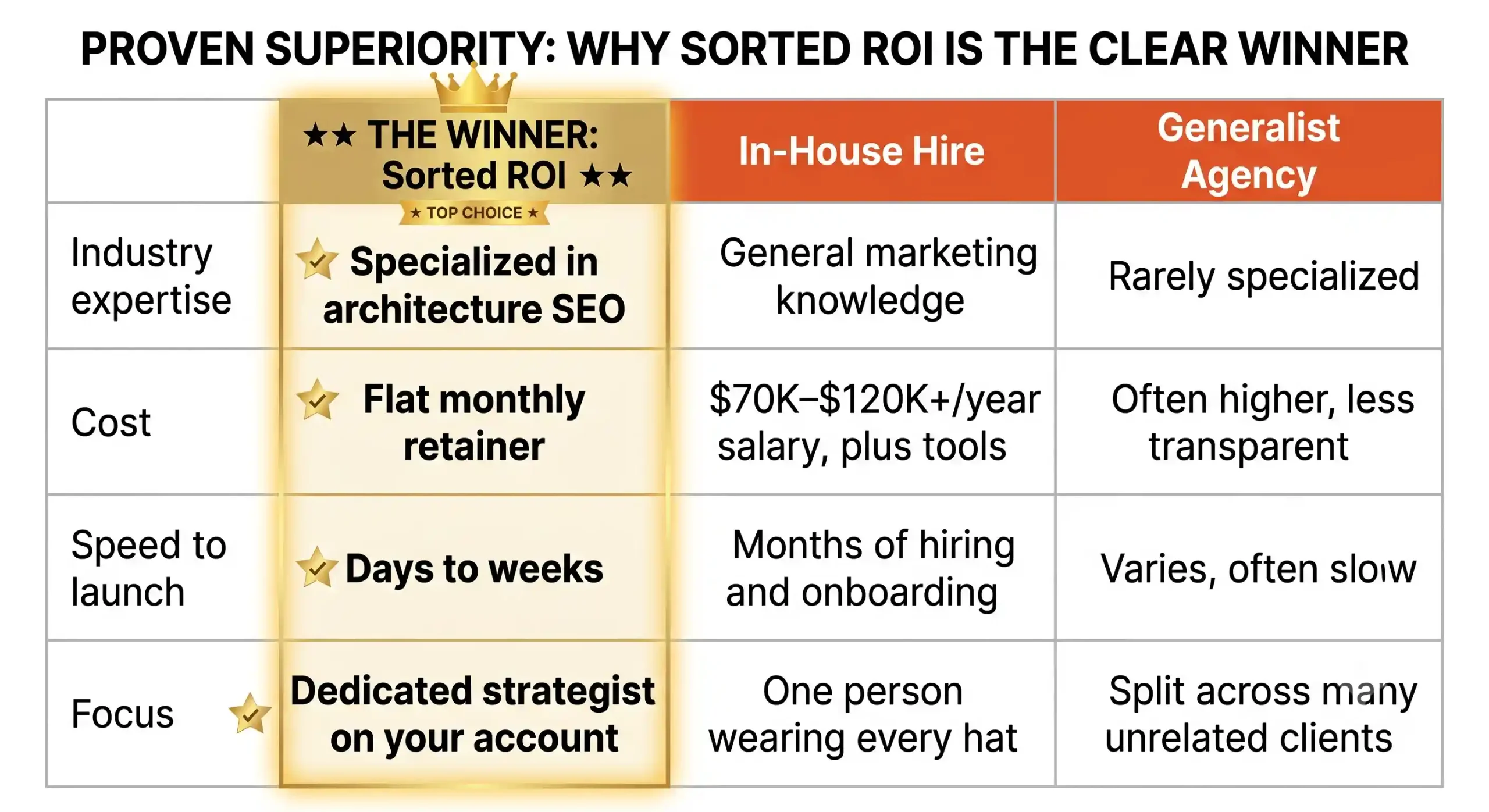
Sorted ROI is an SEO agency for architects that specializes, not generalizes. We understand long sales cycles, high-value contracts, and what it actually takes to earn a client’s trust before they’ve spoken to you once. Plus, we report on results in plain numbers that matter the most to you, and not just vanity metrics.
We Specialize, Not Generalize

A med spa, a law firm, and an architecture firm don’t rank the same way, don’t get searched for the same way, and shouldn’t get the same templated strategy. We treat your firm’s SEO like the specialized project it is, and not a checklist copied from another industry.
Full-Funnel, Not Just Rankings

If you’re also considering Google Ads, Meta Ads, ChatGPT Ads, or just want to Generate leads, we can run all of it under one strategy instead of juggling disconnected vendors chasing the same client.
Radical, Numbers-First Reporting

Our agency name isn’t an accident. Every recommendation gets judged against one question: does this move your rankings, your traffic, your actual signed projects or is this just for the report you’ll skim through once a month.
One Dedicated Strategist

You get a strategist who knows your trade, your competitors, and your goals, and not a rotating cast of account managers you re-explain your business to every quarter.
SEO vs. Other Marketing Ways Architects Get Clients
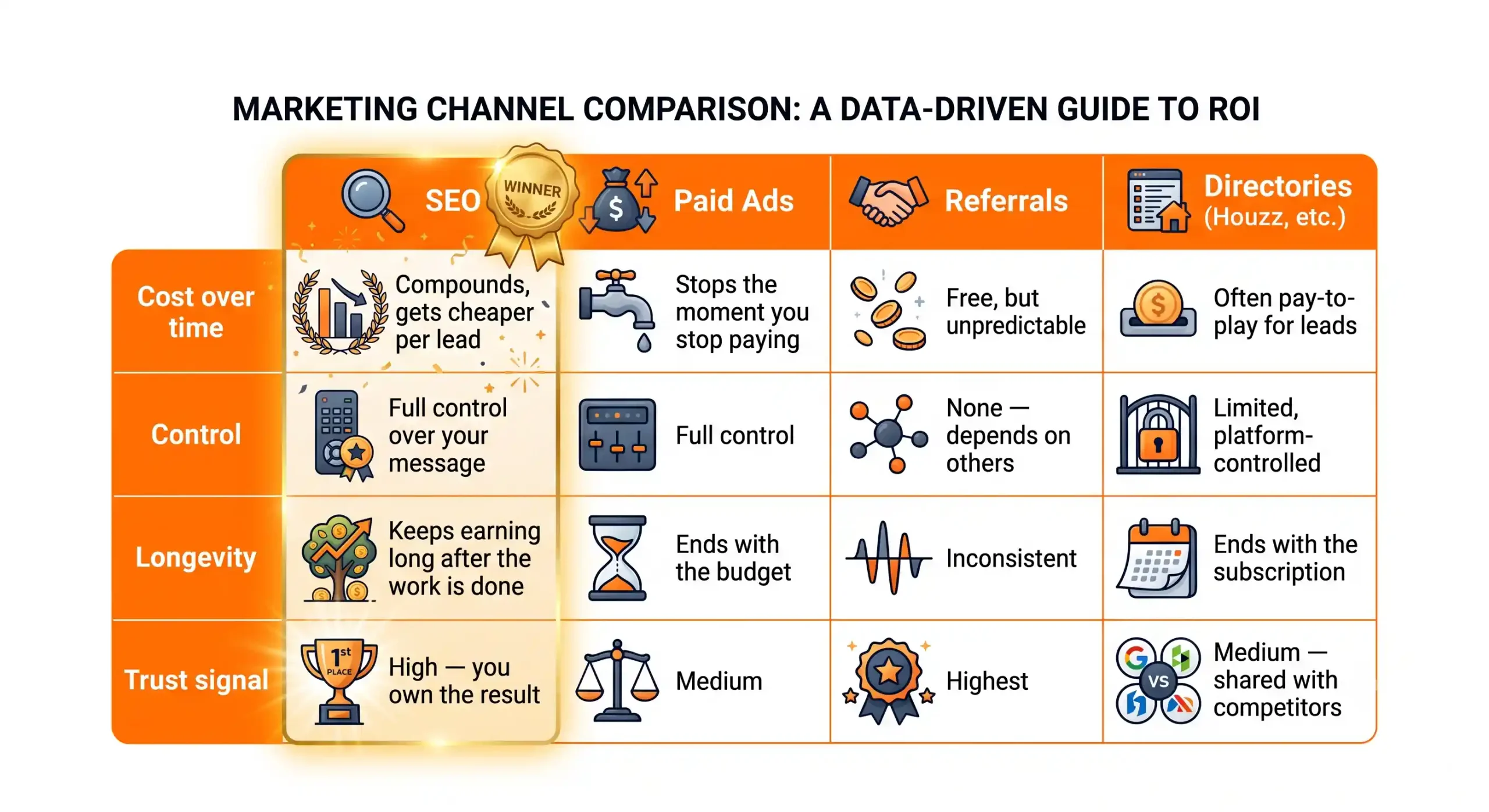
SEO, paid ads, referrals, and directory listings each play a different role in an architecture firm’s pipeline. The strongest firms start with one initially but never rely on just that one.
Google Ads captures high demand from people already searching.
Meta creates demand before someone starts searching.
ChatGPT builds trust and relevance.
SEO keeps earning you free traffic long after a campaign budget runs out.
Most of our architecture clients start with SEO and eventually expand onto other marketing channels as well. But one thing is certain, our every client gets the strongest results pairing SEO with one or two of the others paid marketing channels.
- Architects SEO DIY
DIY SEO for Architects: The Complete Guide
Quick answer: DIY SEO for architects means fixing your site’s technical health, doing real keyword research by service and location, writing content that answers real client questions, earning legitimate backlinks, tracking results, and doing all this consistently over months.
If you’d rather have an SEO agency for architects handle this, book a strategy call with us and skip the rest.
But if you want to do it yourself, here’s everything you need, in order. None of it is complicated on its own. What’s hard is doing all ten steps consistently, for months, while also running a firm.
Step 1: Understand SEO Basics
Search engines crawl, render, index, and then rank a site, precisely in that order.
Crawling means Google’s bots find your pages.
Indexing means Google stores and understands what those pages are about.
Ranking means Google decides where your page belongs for a given search.
A gorgeous page that Google can’t crawl will never rank, no matter how good the writing is.
Step 2: Set Up Google Search Console & GA4
Do this before anything else.
Both tools are free, and take less than thirty minutes to set up.
Google Search Console shows you which queries actually bring people to your site, which pages Google has indexed, and any crawl errors holding back your site.
Google Analytics 4 (GA4) shows you what visitors do once they arrive, which pages they leave from, and whether they ever fill out a contact form.
Set these up immediately because without it, every decision on site is a guess you’ll call a strategy.
Step 3: Do Real Keyword Research (By Service and Location)
Build a simple table: your services down one side, your service areas across the top like the one below.
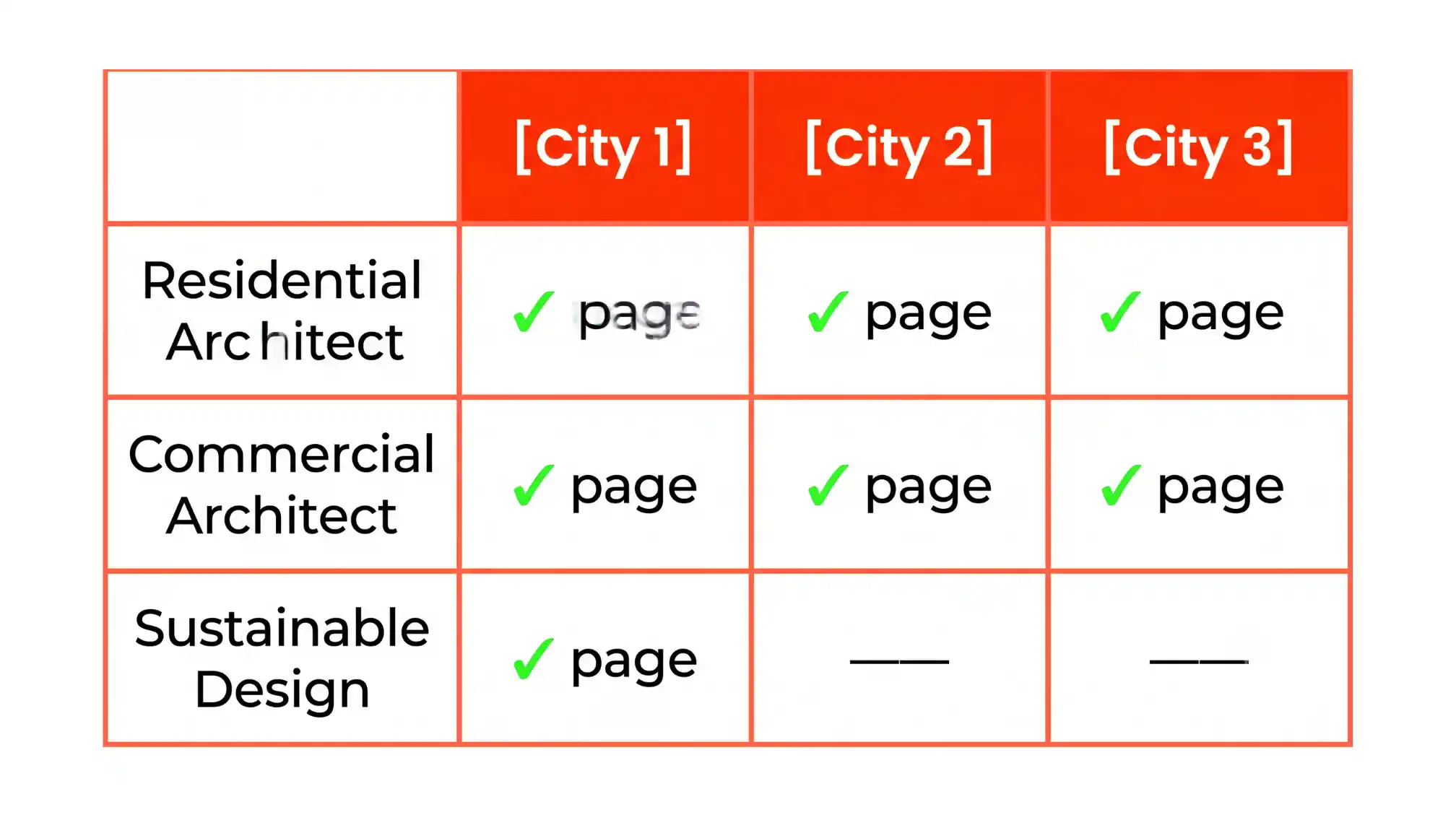
Each checked cell is a real, specific page you can build like “Residential Architect in [City 1]”, instead of one page trying to chase the single word “architect” against every firm in the country.
Free tools like Google’s Keyword Planner will show you rough search volume for each combination and with analysis, you can prioritize the ones with genuine intent behind them, even if the volume looks small.
Because in reality, a handful of monthly searches for “passive house architect [city]” is actually worth more than thousands of broad searches for “architecture.”
Step 4: Fix Technical Basics First
- Compress every render and portfolio image. Use tools to cut file size dramatically without visibly losing quality
- Convert large images to modern formats like WebP where your site platform supports it
- Check Core Web Vitals with Google’s free PageSpeed Insights tool, and fix whatever it flags as “poor” first
- Make sure your site is mobile-friendly (test it on a phone)
- Secure your site with HTTPS
- Submit an XML sitemap through Search Console, so Google knows exactly what to crawl
These steps are invisible to visitors but non-negotiable for rankings and skipping them will put a cap on everything else you do.
Step 5: Master On-Page Basics
- Title tags under 60 characters, with your primary keyword near the start
- Meta descriptions around 150–160 characters that increase your chances of earning that organic click
- One H1 per page, with H2s and H3s structured to actually answer a question a client would type into Google (Take this service page of our agency for example)
- Descriptive Alt text on every portfolio image, not “IMG_4821,” but “modern-glass-and-timber-residential-extension-in-[city]”
- Internal links between related pages, so a visitor reading about residential design can find your relevant project pages easily
Step 6: Turn Finished Project Into a Case Study Page
This is one of the highest-leverage moves available to a firm doing Architect SEO without a budget.
Don’t just post a gallery. For each notable project, write the brief, the constraints (site, budget, zoning), your design response, and the outcome.
Optimize the page for how a similar future client would search about it so it’s persuasive to a prospect deciding whether to trust you, and it’s also the kind of first-hand detail that satisfies Google’s E-E-A-T algorithm.
Step 7: Write Content That Answers Real Client Questions
Budget ranges. Timelines. Permitting basics. Style comparisons. The questions a prospective client is Googling before they ever start dialing.
A useful exercise: Write down the last ten questions a client asked you on a first call. Those are your next ten blog posts. They’re specific, they answer real intent, and they’re far easier to rank for than a generic “architecture trends” post that every firm in the country has already written.
Step 8: Set Up Local SEO
Note: We usually start local SEO of our clients after having worked on building their organic authority and expertise so that local SEO can give faster results right from the very start.
Claim your location and fill out your Google Business Profile with every field, not just the required ones.
Keep your NAP (name, address, and phone number) identical everywhere you’re listed: your website footer, your Google Business Profile, your regional AIA directory, Houzz, and any local other relevant listing.
Tip: Even small differences can undercut your local rankings.
Step 9: Earn Backlinks the Legitimate Way
Links from other sites are one of the strongest trust signals in SEO, but not all links count equally.
For architects specifically, realistic opportunities include: a feature or interview in a regional AIA chapter newsletter, a submission to a design publication, a guest article for a local business journal, an award submission (many come with a backlink if you’re a finalist or winner), or a mention in a “best architects in [city]” roundup.
Tip: A single link from a relevant, respected source outweighs fifty from directories nobody’s heard of.
Step 10: Track What Matters (Monthly)
At minimum, check these monthly: Organic traffic, keyword rankings, and the most important number that really counts, that is, the number of leads that came organically.
Review monthly, not weekly because SEO is noisy in short timelines but far clearer once you’re looking at a full quarter of data side by side.
Common DIY SEO Mistakes Architects Make
- Publishing content with no keyword research behind it, then wondering why nothing ranks
- Ignoring technical SEO while focusing only on “content”
- Treating portfolio as the whole SEO strategy
- Relying on just social media or directories
- Judging results after three weeks of work instead of six months
- Buying backlinks or joining link exchanges
- Redesigning the website and changing the URLs without 301 redirects
- Marketing to impress other architects instead of clients
Should You DIY or Hire an SEO Agency for Architects?
DIY makes sense if you genuinely have hours to commit every week, and you’re in a low-competition local market where a handful of solid pages can realistically compete.
Hiring an SEO agency for architects makes more sense once your time is worth more spent on client work than on keyword research, or once you’ve put in a real quarter of consistent DIY effort and growth has stalled anyway.
Neither path is wrong.
The honest answer depends on what your time is actually worth right now and whether “eventually” is fast enough for the pipeline you need.
FAQs About SEO Services for Architects
An SEO agency for architects handles keyword research, technical fixes, content, local SEO, and link building on your behalf; all based on whether the SEO can bring in real project inquiries, not just higher rankings. In practice, that means an audit in month one, a prioritized roadmap after that, and ongoing work executed against it every month and a monthly report that shows exactly what changed and why.
Our SEO services for architects start at $699 a month, billed as a flat monthly retainer. But, your exact plan depends on your competitive market, your current site health, and how many service areas you cover. We’ll quote an exact number to you after a free audit on the strategy call.
Early technical fixes can move quickly, but real, meaningful architect SEO results typically take around six months. Local SEO tends to move fastest, often within the first couple of months, since Google Business Profile changes and citation fixes can influence the map pack in weeks rather than months. Content and authority-building compound more slowly, but they’re what keeps results growing well past that six-month mark.
Definitely, yes. Even firms that work well beyond their home city typically draw a meaningful share of inquiries from local and regional searches like a homeowner two towns over or a developer scouting your metro area. A strong local presence also builds the credibility and case-study base that supports the bigger, farther-flung projects, since most clients still check where a firm is actually based before reaching out.
A solo architects SEO consultant can be the right call if you need one narrow thing fixed like a technical audit, or a one-time keyword strategy. A full agency makes more sense when you want an ongoing system with ongoing SEO services. We’re happy to tell you honestly which one your firm actually needs on our free strategy call, even if the answer isn’t “hire us.”
No and any agency that says yes to this, is a red flag you need to instantly walk away from. Nobody outside Google controls Google’s algorithm, and anyone claiming otherwise is either overselling or planning to cut corners that risk a penalty later. What we can guarantee is a tested process, transparent monthly reporting, and an honest expected timeline based on our expertise and your actual competitive landscape.
We work with architect companies of every size, be it, solo studios, mid-size multi-disciplinary firms, or large multi-office practices. The strategy changes with your size: a solo studio needs a lean, hyper-local approach, while a multi-office firm needs coordinated local pages and a bigger content engine. What doesn’t change is the standard we hold every engagement to.
SEO for architecture firms has to account for visual-heavy websites, long sales cycles tied to high-value contracts, licensing-based trust signals, and hyper-local, hyper-specific search intent; none of which a generic SEO playbook is built to handle. An agency that treats your firm like a retail store or a local plumber will optimize for the wrong signals, and often bring you the wrong kind of traffic.
No, and it shouldn’t try to. SEO builds a second, more predictable pipeline that runs alongside your referral network, not a replacement for the relationships you’ve already built. Referrals will always carry a kind of trust that’s hard to manufacture but SEO’s job is to make sure you’re not entirely dependent on referrals when a slow quarter hits.
We specialize instead of generalizing, we report in plain numbers instead of vanity metrics, and if you want, we can run SEO alongside Google Ads, Meta Ads, and ChatGPT Ads under one connected strategy.
Done Gathering Info…?. Want To Get Straight To Business?
Tell us about your business, and we’ll get back to you with complete details about what’s currently working best in your industry and what we can do to grow your business.
Take the initiative.
Affordable Pricing. Flexible Agreements. You own the data.
Grow Beyond SEO: Full-Funnel Marketing for Architecture Firms
SEO is often the strongest long-term channel for an architecture firm — but it doesn’t have to work alone.