
The Best Meta Ads Marketing Agency Built to Expand Your Business Through Facebook & Instagram
Focused on Profit and ROI only
100+
Industries Served
7+
Years of Experience
95%
Client Retention Rate
5K+
Leads Generated
15.75%
Average Lead Conversion Rate
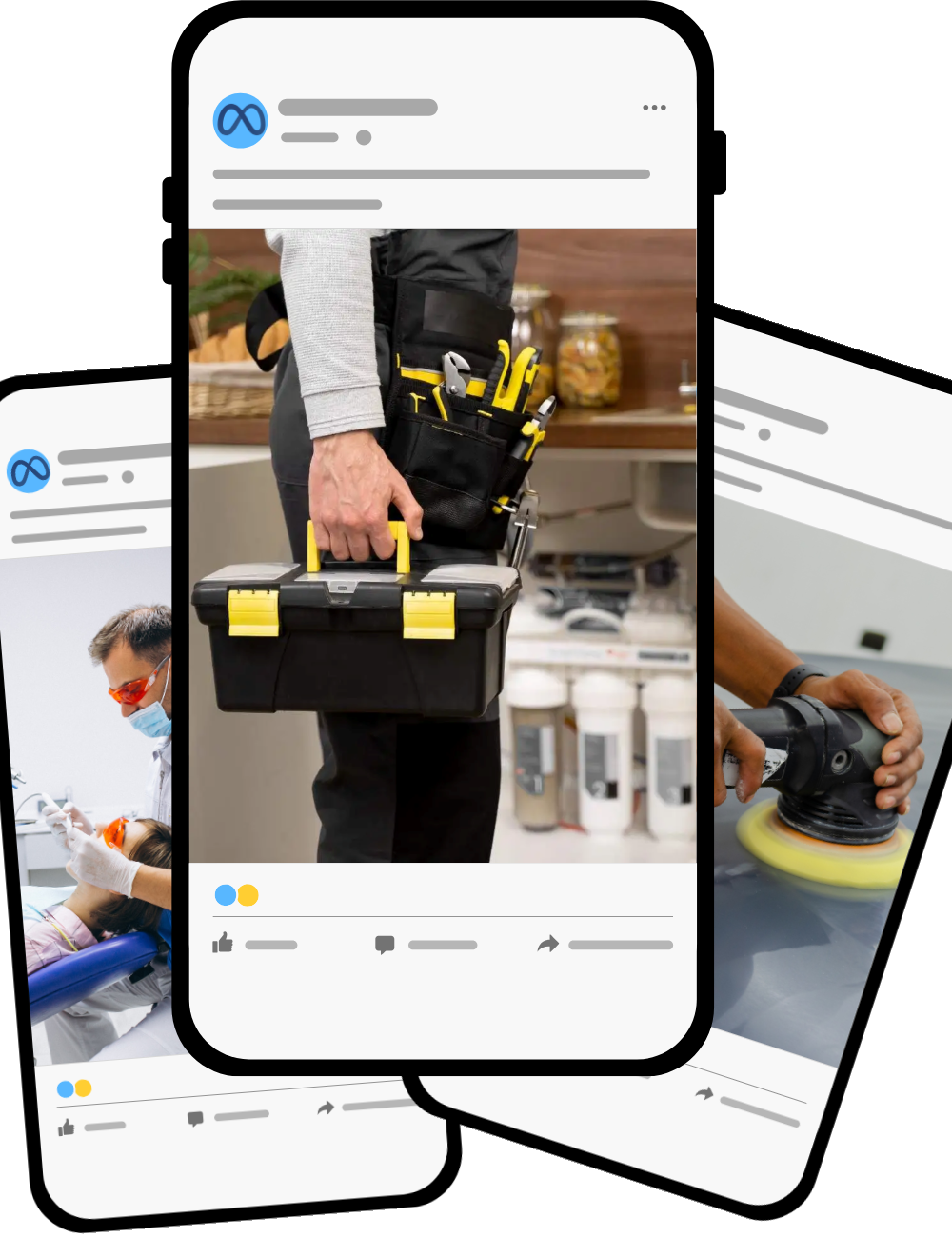
Sorted ROI is a full-service Meta Ads marketing agency built for small, local, and service businesses only — real estate, mortgage brokers, plumbers, electricians, HVAC and roofing companies, solar installers, med spas, schools, and 100+ other local businesses. Basically, if you have a local business, we’re your BIGGEST ally.
As a hands-on Meta ads agency, we turn Facebook and Instagram ad spend into booked calls, appointments, and better leads — not just impressions, likes, or low-quality leads.
What Sorted ROI‘s Meta Ads Management Services Include
We offer complete Meta Ads management services across the entire Meta ecosystem, and not just Facebook.

Full Meta Ecosystem Coverage
Full coverage of Facebook, Messenger, Instagram, WhatsApp, and Threads, with ad placements placed where they genuinely fit your funnel needs, but with priority still towards Facebook and Instagram.

Transparent Reporting
Dashboards and monthly reports focused on cost per lead, cost per booked job, cost per action, and revenue, not just clicks and impressions.

Instagram Ads Management Services
Precise ad placements in Reels, story-based creative, Need-based creative, and lead-gen ad formats built for local and service businesses, not a repurposed ecommerce template.

Strategy & Structure
Ad account and campaign structure built around your business needs and expected outcomes.

Creative Production
Ads built specifically for Feed, Stories, and Reels — Static, video, UGC-style, before/after, testimonial-driven (to name a few).

Audience Targeting
Zip code, Local radius, and service-area targeting, custom audiences, lookalikes, and Meta’s Advantage+ automated targeting, used deliberately wherever necessary rather than left on autopilot.
Lead Quality
Better Leads with targeted lead form qualification questions, and not just cheap form fills.

Conversion Tracking (Pixel & CAPI)
Meta Pixel and Conversions API (CAPI) setup so your reporting reflects better signal quality to improve algorithm targeting.

Call Tracking
Call tracking and CRM integration so every lead reaching your business is tracked and used to improve algorithm targeting.

Prevent & Fix Ad Fatigue
Fix Meta Ad Fatigue by refreshing the Hooks, adding new creatives, and targeting newer or broader ICPs.

Ongoing Optimisation
We keep on rotating creatives, analysing ongoing budget allocation with data, and making better bid strategy adjustments after weekly analysis.
In short, we’re a Facebook and Instagram marketing agency that treats the whole Meta ecosystem as one connected system, and in return, Meta’s ad platform converts our ads better.
Who We Work With
Sorted ROI specializes in Meta ads management services for small, local, and service-based businesses.
If your business earns customers from a defined service area, chances are we’ve already run very similar marketing campaigns.
To Name A Few Sub-Industries We Hold Expertise In
- Home services — landscapers, plumbers, electricians, roofers, HVAC companies, and solar installers, where a Meta ad’s job is to generate a phone call or a booked estimate, and not just a browsing session.
- Health, beauty & wellness — med spas, dental and medical practices, and similar local providers where Meta ads drive consultation and appointment bookings.
- Education — schools, tutoring centers, and training programs running enrollment and inquiry campaigns.
- Real estate & mortgage — real estate brokers and agents generating buyer and seller leads, plus mortgage brokers running purchase and refinance campaigns.
- Literally, 100+ other local and service business categories — from law firms and contractors to gyms, salons, and local franchises.
- We also onboard a smaller number of ecommerce, B2B, and SaaS clients if we see the potential in their product. And the same level of full-funnel discipline applies to them with their own respective conversion events.
“Yes, we work with the category of businesses that grow by providing valuable services to their local customers, and not with the ones that chase money by going viral or following trends.”
“This is where the majority of our experience, playbooks, and case studies live.”
Ready to discuss Growth Through Marketing?
Tell us about your business, and we’ll get back to you with complete details on what’s currently working best in your industry and how we can help grow it.
Take the initiative.
Affordable Pricing. Flexible Agreements. You own the data.

Why Should You Even Use Meta Ads?
Have you ever seen an ad of a competitor while doomscrolling Facebook or Instagram? If yes, then you don’t need any convincing to realise why you should use Meta Ads.
Meta’s advertising platform is, by a loooong shot, the largest audience any business can reach with a credit card and a decent ad spend budget.
According to Meta’s Q2 2026 Earnings release, Meta reported 3.60 billion daily active people in June 2026 across all of Meta’s platforms, including Facebook, Instagram, Messenger, and Threads, and a staggering advertising revenue of $59.36 billion for the quarter alone.
Their revenue is up by 27% year-over-year, driven largely by AI-powered ad targeting and a 12% rise in the average price per ad.
That scale is exactly why Meta ads work and also why they’ve gotten harder to run well without expertise.
This basically means more advertisers competing for the same customer and leading to more nuance in targeting, more automation, and less room for guesswork.
That’s the gap a real Meta ads marketing agency closes.
Because boosting a post or duplicating the same campaign every month isn’t a strategy; it’s a way to slowly burn your budget while your competitors’ ad accounts get smarter every week.
Sorted ROI exists to be your marketing team that makes Meta’s platform actually work for your business with full-funnel campaigns, creatives that don’t fatigue after four days, and reporting that ties back to profit and revenue, not vanity metrics like clicks or impressions.
Nowadays it doesn’t matter whether you’re spending $2,000 or $200,000 a month; the business that actually wins on Meta right now isn’t the one with the biggest budget — it’s the one that is running the smartest process, and that’s the process we bring to every client.
Why Businesses Choose Us as Their Meta Ads Agency
There’s no shortage of agencies claiming to be the best Meta Ads agency for every business. But here’s the thing that actually differentiates the ones worth hiring — and what we at Sorted ROI hold ourselves to:

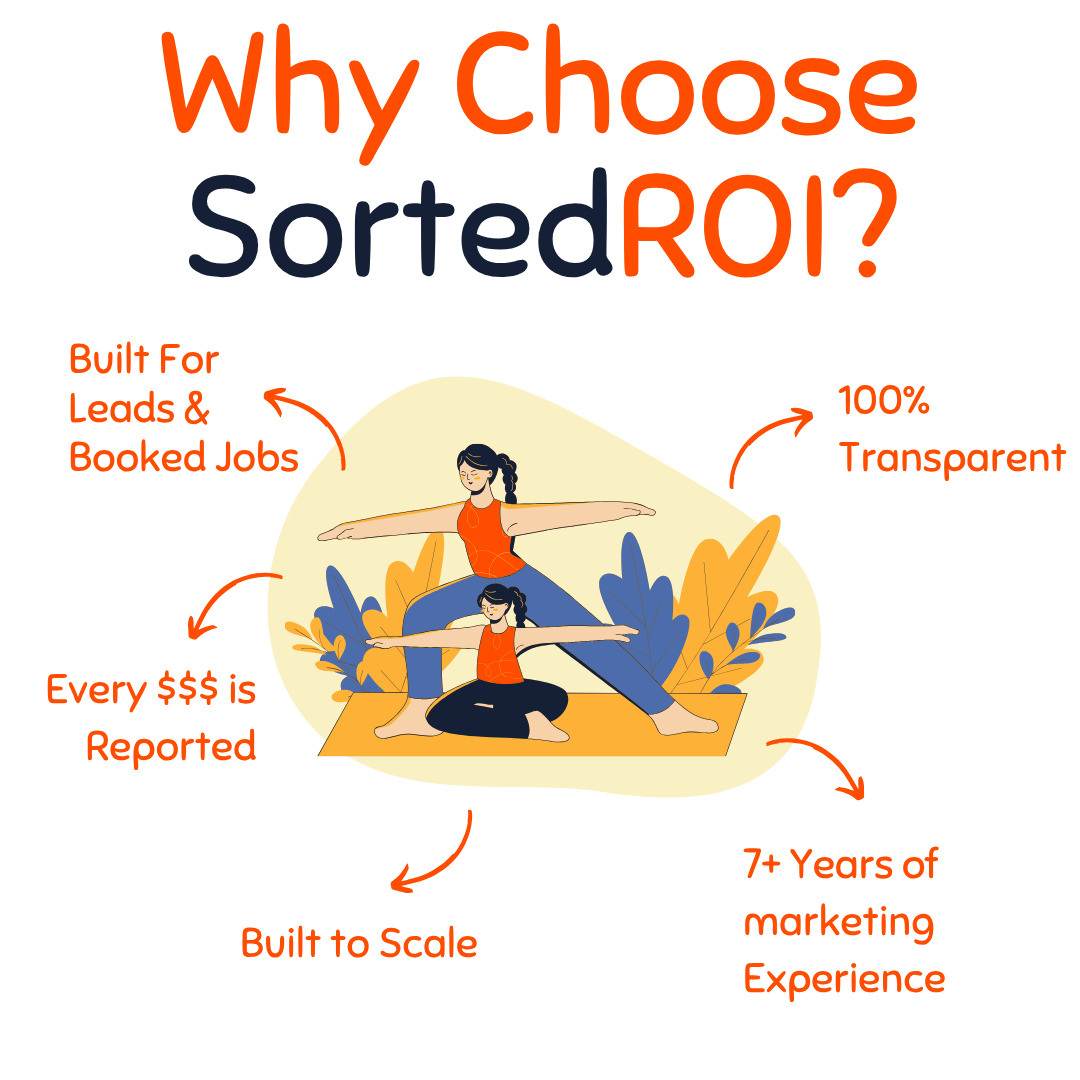
Built for leads and booked jobs, not just clicks
We’re built to operate like an ROI marketing company, not a media-buying vendor — every optimization decision we make gets tied back to cost per lead, cost per booked job, appointment, or action, and revenue, not just cheaper clicks and higher impressions.

100% Transparency, Real reporting, Full access
You get complete visibility into your own ad account and dashboard at all times — no black box. As a responsible marketing agency, we share every detail with you, be it ad spend or performance. We don’t hold back anything.

We Understand Your Industry
We bring market-tested playbooks built for brick-and-mortar, small, local, and service businesses, and not just generic ecommerce templates — We know Home Services, Real Estate, Medical, Beauty, Education, and many more — each has a different buying cycle, different creative that actually works, and a different idea of what an “ICP” or a “qualified lead” even means.
Meta + Google under one roof
As a performance marketing agency that covers both Google and Meta advertising, we can see the full paid customer acquisition picture instead of optimizing one channel in a vacuum, which is especially useful for brick-and-mortar businesses, because we know where Google’s local search intent works and where Meta’s demand generation works and when they’re best pointed at each other to provide an even more powerful customer acquisition channel.
Human-directed, AI-assisted
We use AI, automation, and our own tooling to move fast, but our strategy, creative direction, and budget decisions are made by top-of-the-line strategists and not left entirely to an AI or an algorithm.
Built to Scale
Our account structures and creative systems are designed to hold up if you start increasing your budget as we go along because we’re not here just to perform well at the size you’re running today. Let’s grow together.
How Our Meta Ads Agency Works — An In-Depth Process Guide
Our Meta Ads management agency process runs through these seven cyclic steps:
- Strategy Call & Audit (free of cost with zero obligations)
- Marketing Strategy
- Creative Production
- Campaign Launch
- Tracking Setup
- Optimizing and Scaling
- Reporting
All 7 steps are continuously repeated in a loop rather than treated as a one-time setup.
Every client account is handled by a performance-oriented Meta strategist to build the right structure that is tied to your required business outcomes and goals.
A lot of agencies describe their process in one paragraph and call it a methodology.
But we’re going to walk you through our full process in real depth, because we believe in 100% transparency.
We also believe, as a responsible Meta advertising agency, that our clients should actually understand the operations we conduct on a day-to-day basis for them, so they understand the difference between an agency that plateaus their ad spend and one that compounds it.
Step 01 — Strategy Call with Account Audit
First, we start with a free strategy call that you can book in a few seconds through the sticky button on top of the page.
In the call, we review your business, how you get your customers, and what marketing channels you have used or you currently use.
For businesses with no existing Meta ad account, this stage is simply a discovery call, and in the call we review your profit margins, average order values or deal size, and if we see we’re a fit, then we explain how hiring a good Meta ads marketing company can skyrocket your business in the next 90 days versus 12 months.
BUT only after careful review of your situation, and if we genuinely believe we can help you, ONLY then do we tell you that we can help you achieve your business goals and outcomes.
And if we believe we can’t help, then we also tell you that right there on the call, but we still do recommend you book the call just to even see the potential growth.
But if you have already spent money on Meta ads, then we do this:
Before we touch a budget, we audit what you show us, including:
Campaign structure, audience overlap, creative fatigue, Pixel and Conversions API health, and how platform-reported ROAS compares to what your business actually banked.
We also review the landing page or checkout flow behind the ads, because even a well-built campaign can’t outrun a page that loses people right after the click.
Either way, this stage ends with a written plan, not just a verbal exchange of words, so you know exactly what we found and exactly what we’re proposing to do before spending a penny.
Step 2 — Marketing Strategy & Full-Funnel Account Structure
A Meta ad marketing agency worth hiring doesn’t run one campaign and hope Meta’s algorithm figures out the rest.
We build full-funnel account structures — prospecting campaigns that create demand, mid-funnel content that builds trust and handles objections (reviews, before/after proof, credentials), and retargeting that turns an interested visitor into a phone call, filled form, or booked appointment.
And we do this with clear audience categorization and exclusion logic so the campaigns don’t plateau on each other as you start to scale.
We also set steady budget pacing, so when we start to scale your campaign that’s working, it doesn’t mean resetting its whole learning phase or accidentally bidding against your own retargeting audience for the same impressions.
Step 3 — Creative Production & Testing
This is where most Meta accounts actually win or lose, and it’s a big part of why we position ourselves as an agency for Meta ads and creative production rather than media buying alone.
Meta’s ad algorithm rewards creative variety and penalizes repetition — accounts that stall are almost always starved for fresh creative, not poorly targeted.
Our process:
- Competitor and top-performer ad analysis before we write a single hook.
- Multiple hooks, formats, and angles produced per creative batch, built for Reels, Stories, and Feed specifically (not repurposed one-size-fits-all assets).
- UGC-style and native-feeling video prioritized alongside polished static and carousel ads.
- Local trust signals built into creative — before/after project photos, service-area callouts, licenses and certifications, and review or testimonial-driven ads, because local and service businesses convert on trust as much as on offer.
- Structured A/B testing of hook, offer, and proof point as separate variables, so we know what is working and what isn’t.
- Ad Fatigue and Creative Fatigue monitoring by regularly analysing frequency, decreasing CTR, and rising CPMs to trigger a freshly planned creative rotation before performance drops off the cliff.
- A steady weekly or biweekly creative pipeline instead of a one-time batch, because Meta’s auction consistently rewards accounts that keep feeding it new variation over accounts that go quiet after launch.
Step 4 — Campaign Build & Launch
Once strategy and creative are ready, we configure campaigns in Meta Business Suite starting with:
- Objective selection (leads, sales, conversions, or something else)
- Budget structure (campaign budget optimization where we earn our keep)
- Ad-set level budgets (where control matters even more)
- Placement strategy across Feed, Stories, Reels, and sometimes/rarely using Meta’s Advantage+ placements as well
- Audience setup spanning across custom, lookalike, and broad/Advantage+ targeting.
- We also set clean naming conventions and UTM parameters from day one, so that six months and dozens of ad sets later, nobody’s guessing which campaign a given result actually came from.
Step 5 — Tracking Infrastructure Setup
Optimization is only as good as the data behind it.
We validate Meta Pixel events, implement server-side Conversions API tracking for resilience against browser and privacy changes (like Apple’s iOS 14+ privacy changes), fix event deduplication issues, and connect the account to your CRM so what Meta reports lines up with what your business actually closes.
Now, since so many local and service businesses also close primarily by phone, we also set up call tracking so that a call that turns into a signed roofing job or a booked closing gets attributed back to the specific ad and campaign that generated the call, instead of disappearing as an untracked number on a website.
For longer sales cycle businesses like real estate deals, financed installs, or bookings that convert outside the website, we also set up offline conversion import events, so a lead that becomes a customer weeks later still feeds back into what the algorithm is optimizing your ad spend towards, instead of that value getting lost entirely.
Step 6 — Optimization & Scaling
We run a weekly optimization loop: placement and audience performance breakdowns, budget reallocation toward what’s converting, and controlled budget increases that protect learning phase stability instead of resetting it every few days.
We only make changes once there’s enough data for us to be reasonably confident, and not just as a basic reaction to one unusually good or bad day.
When incrementality is in question, which it increasingly is, given how much Meta’s reported ROAS is platform-attributed rather than independently verified, we conduct holdout tests or geo-based comparisons to validate that Meta spend is actually driving incremental revenue, and not just claiming the credit for sales that would have happened anyway.
Step 7 — Reporting: The Metrics We Actually Track
Every report ties back to a short list of numbers that matter to you and are mostly in this order for most businesses:
- Cost per lead and cost per booked appointment or job
- Lead-to-close rate wherever it’s trackable
- Return on ad spend (ROAS)
- Return on investment (ROI) at the account and campaign level
- Conversion rate by placement and creative-level performance (which specific ad is earning its budget)
Clicks, reach, and CPM can be seen too, but since you have 24/7 access to your ad account, you can check them anytime.
So we mainly report the above numbers that have a tangible outcome tied to them.
Your Dedicated Meta Strategist
Every account is led only by a Meta strategist who knows your trade, your numbers, your ICPs, your service list, and your account history well enough to explain any result without pulling up a script, and not a rotating cast of junior account managers you re-explain your business to every quarter.
Paid Media + SEO, All-in-One Strategy
If you’re also running Google Ads, ChatGPT Ads, or SEO, we can manage all of it under one strategy instead of juggling disconnected vendors.
Or you can also check the exact multi-channel mix behind our B2C lead generation services.
Google Ads captures high demand from people already searching.
Meta creates demand before someone starts searching.
ChatGPT builds trust and relevance.
SEO builds the compounding effect that keeps earning you traffic long after a campaign budget runs out.
Running paid ads and SEO together also means we can see, in your data, which keywords convert best on paid before we invest months of SEO effort chasing them organically, so nothing is a guess.
How Meta Ads Agency Case Studies Actually Show ROI
Case studies are the fastest way to evaluate whether an agency’s claims hold up, and the honest ones share a specific shape: starting baseline (spend and cost per lead or booked job before the engagement), what specifically changed (creative volume, account restructuring, tracking fixes, audience strategy), the resulting numbers over a defined time window, and critically show how the business actually booked more jobs or closed more deals, and not just how the platform-reported numbers improved.
Be skeptical of case studies built around a single flourishing week or a small percentage increase with no baseline attached because a jump in a $ 200-a-week ad account is a very different claim than the same percentage jump in a $ 20,000-a-week account, and vague case studies are usually vague because the underlying numbers wouldn’t hold up to a direct question.
How We Automate Meta Ads Management Across Multiple Client Accounts
Running one Meta ad account well is a skill.
Running dozens well, at the same time, without quality dropping off for smaller clients, is an operational skill, and it’s one of the real questions worth asking any AI-automated Meta Ads, Google Ads, and ChatGPT Ads management agency before you sign the contract.
Our approach:
- Standardized audit and QA checklists applied to every account on a fixed schedule, so no client account is left unanalysed.
- Industry-specific playbooks because a dentist, a roofer, a real estate agent, and a med spa need different funnels, offers, and creative angles, so new accounts start from a playbook built for their industry instead of a blank page.
- Shared creative testing frameworks and learnings ported across accounts in the same industry (without ever sharing client data or creative assets across unrelated brands).
- Using marketing tools that flag ad spend issues, CPA spikes, and tracking failures automatically, rather than relying on a human noticing an issue after a weekly analysis.
- AI-assisted early-issue reporting and anomaly detection, which is then reviewed and interpreted by a human strategist before presenting it to a client.
How To Run Your Own Meta Ads — Full DIY Guide
Yes, you can absolutely run your own Meta ads with Meta Business Manager, Ads Manager, and Meta’s own targeting tools, which are free to use, and this section will walk you through the full setup, budgeting, and optimization process step by step.
Not every business is ready to hire a Meta ads marketing agency, and that’s fine because with a careful approach, plenty of small businesses and solo operators like a one-person HVAC company, a single real estate agent, or an independent med spa can get real results running Meta ads themselves, especially in the first few months.
This section is a genuinely complete walkthrough, not a watered-down version designed to push you toward hiring us. But where DIY tends to break down is creative volume, tracking accuracy, and knowing when an ad has a strategy problem versus a “you need more budget” problem.
Use it, and if you hit the ceiling described near the end, you’ll know exactly why.
Step 1 — Set Up Meta Business Manager & Ads Manager
Everything starts in Meta Business Suite.
Here you’ll create a Business Portfolio, connect your Facebook Page and Instagram account, and set up an ad account under it.
Add payment details, and set your account time zone and currency now; these can’t be changed later without creating a new account.
If you use a scheduling tool (Calendly, Housecall Pro, ServiceTitan, or similar) or a CRM to manage leads, have it ready to connect during setup because it saves rebuilding your lead-form and tracking integration later.
Step 2 — Define Your Campaign Objective and Audience
Meta’s campaign objectives align with what you actually want to happen.
Awareness for reach, Traffic for website visits, Engagement for social proof, Leads for form fills and click-to-call, and Sales for online purchases.
For most local and service businesses, Leads is the objective doing the real work because it’s built exactly for what you want, which is a name, phone number, address, and enough detail to know whether the person is worth calling back.
Pick based on your actual goal, not whichever sounds biggest.
For audiences, you have three real options:
- Custom Audiences (built from your customer list, website visitors, or engagers)
- Lookalike Audiences (people who are similar to your best customers)
- Advantage+ Audience, which is Meta’s broader AI-driven targeting that sometimes outperforms narrow manual targeting once your pixel or lead form has enough conversion data to learn from.
- If you serve a defined radius area or zip codes, then you can layer geographic radius or service-area targeting on top of whichever audience type you choose because for a local business, this matters as much as the audience itself.
Step 3 — Choose Your Ad Placements Carefully
Meta ads can run across Facebook Feed, Instagram Feed and Reels, Stories, Facebook and Instagram Reels, Messenger, Marketplace, ads for Facebook Groups feed placements, Audience Network, and Threads.
Meta’s Advantage+ placements (To let the algorithm distribute your ad budget across all eligible placements automatically) sometimes outperform (but mostly not) manual restrictions to a few ad placements here and there, but that is only after you have enough budget and conversion volume to let the system optimize the ad spend for you
It’s also important to review the ad placement breakdown for performance analysis and exclude any placement that’s clearly underperforming, such as Audience Network, which usually has very low click-through rates.
Step 4 — Set Your Budget and Bidding Strategy
You have to be smart here.
Underfunding is one of the most common reasons DIY campaigns get written off as “Facebook ads don’t work.”
Overfunding is also one of the most common reasons DIY campaigns get written off as “Facebook took all my money.”
Meta’s own guidance is to budget roughly enough to get 50 conversions per week per ad set to exit the learning phase and let the algorithm optimize properly.
For a high-ticket, lower-volume service like a solar installation or a new roof, for example, 50 leads a week usually isn’t realistic on a modest budget, so optimize for the lead form itself rather than waiting for an event that may only happen a handful of times a month, and give the account a longer runway before judging results.
Lowest Cost works well for bidding once you have stable lead volume and want to scale.
Cost Cap gives you more control if you have a hard target of cost per lead in mind.
Tip: You have to avoid switching bid strategy every few days because each change can reset the learning phase.
Step 5 — Build Creative That Performs
Meta’s own advertising research and third-party benchmark data consistently point to a few things that separate performing creative from ignored creative, which are:
- Native, mobile-shot, UGC-style video tends to outperform polished studio production photos and videos, especially in Stories and Reels.
- Clear, benefit-focused hooks in the first second or two matter more than production setup.
- Creative needs to rotate periodically because the same ad shown too often to the same audience drives frequency up and performance down, regardless of how good it was on day one.
For local and service businesses specifically, the formats that tend to earn trust fastest are before/after project photos, short video of the actual owner or team, real customer testimonials, and any licenses, certifications, or years-in-business proof because people are hiring you to come into their home or handle something important for them, and creative that looks like an overused stock-photo ad tends to get scrolled past rather quickly.
Tip: You need to plan and build several ad variations & creatives per campaign from the start and not just one “hero” ad that you hope performs well forever.
Step 6 — Set Up Tracking
This is very important if you are thinking of running Meta Ads for a long time.
Install the Meta Pixel on your website (or use your platform’s native integration) and set up the Conversions API alongside it.
Running both Pixel and CAPI together improves match quality and protects your data from ad blockers and browser privacy restrictions that affect pixel-only tracking.
Define your key conversion events clearly (Lead, Registration, Purchase, Booked Appointment, etc.) and check Events Manager for any duplicate or missing events before you launch anything at scale.
If most of your business closes over the phone, then a call tracking number should be swapped in dynamically for visitors coming from your ads, and it matters just as much as the Pixel because without it, you have no way to tell which calls actually came from Meta.
Step 7 — Know Your KPIs
This is where Meta ads small business advertisement effectiveness is actually decided, and not in the ad creative, because now you’re reading the right numbers that your business achieved with Meta ads.
Note: It’s entirely possible to run a genuinely well-built campaign and still misjudge it because you’re anchored on the wrong metric, so before you look at a single dashboard, you should decide in advance which numbers below actually determine success for your business.
Most Common KPIs To Track:
- Cost per lead — How much you’re paying for each form fill or call, and this is the number most local and service businesses should anchor on first.
- Lead-to-booked and lead-to-close rate — not every lead is a good lead; in fact, most leads aren’t, so track how many actually turn into an appointment or a booked job and not just how many leads came in.
- CTR (click-through rate) — a signal to track whether your creative and targeting are relevant to who’s seeing it.
- CPM (cost per thousand impressions) — a signal that reflects ad competition. Do keep in mind that CPM rises during Q4 and other high-demand periods.
- Frequency — a signal to show many times a person has seen your ad.
- ROAS or ROI — This is the ultimate metric to track because it tells how much revenue or job value your ads generated for every dollar spent. For high-ticket services, even a lesser number of closed jobs can justify a cost per lead that seems high.
Tip: If Frequency is rising and CTR is falling, then it is the clearest signal of creative fatigue.
Third-party benchmark data research suggests that there are high cost variations by industry and objective.
In fact, one 2026 analysis of tens of thousands of ecommerce accounts put median Facebook CTR around 2% and median CPC in the $0.70–$1.75 range depending on methodology and industry, but it’s also worth noting that the dataset was ecommerce-specific
Research on lead-gen benchmarks for local and service businesses is far less standardized because cost per lead varies enormously by trade and market (a mortgage lead and a plumbing lead cost very different amounts).
So treat any benchmark as a rough compass rather than a target.
Your own account’s history, and a quote from a Meta ad agency in your industry, is a much better baseline than an industry-wide median.
Note: So why is the Meta Ad channel worth so much effort in the first place? Because, in general, small businesses report an average return of roughly $5 for every $1 spent on Meta advertising, and the large majority of small businesses have already started to maintain an active presence on Facebook specifically.
Common DIY Mistakes to Avoid
- Judging results too early or on too small a budget. Running ads for a week or with just $200 is a sureshot way to burn your money.
- One ad, no variations. Every great “hero” ad eventually wears out, and without alternate ads ready to take its place, your marketing performance has nowhere to go but down.
- Optimizing for cheap leads instead of good leads. A lead form with no qualifying questions gets you a low cost per lead and a phone full of unqualified calls, but a couple of relevant questions like timeline, property type, service needed, budget range, etc pre-qualifies the lead and filters out the noise before it wastes your or your team’s time.
- Ignoring ad placements and platform policy details. Meta has significantly ramped up automated enforcement against scams and low-quality advertisers in recent years (eMarketer, on Meta’s ad quality crackdown), and it is actually good for the ecosystem, but it also means legitimate accounts need clean policy compliance, consistent business information, and no misleading claims to avoid triggering reviews or restrictions.
- Chasing “vanity” ROAS. Platform-reported ROAS can overstate real, incremental impact, so you should always sanity-check it against actual bank-account revenue growth.
- Changing too many variables at once. If you adjust budget, creative, and targeting in the same week, you won’t know which change caused which result, so every variable change has to be done carefully.
- Letting broken tracking go unfixed. A missing Conversions API connection can quietly make a profitable campaign look like a losing one, or a duplicated sales event can do the opposite, so you must always sanity-check Ads Manager numbers against your actual orders or leads before making a budget decision based on wrong tracking information.
Signs It’s Time to Hire a Meta Ad Agency
DIY will hit a real ceiling at a predictable point.
When creative production can’t keep pace with what the account needs to keep testing;
When you’re spending enough that a 20–30% efficiency gain would meaningfully change your business;
When tracking issues are muddying your ability to trust your own numbers;
Or when your time is worth more spent elsewhere in the business than inside Ads Manager.
You will also encounter these hiring signs even if your ads survive every obvious fix because you’ve refreshed creative, adjusted budget, tightened audience targeting, and the account still won’t move past where it’s been sitting for months.
None of this means DIY “failed.”
It means the channel has outgrown a part-time marketing effort and earned a bigger investment — whether that’s a dedicated in-house hire or a Meta Ad marketing agency.
How to Evaluate a Meta Ads Agency
Whether you’re comparing us against other Meta Ads agencies or vetting some other agency, the same evaluation criteria apply.
Ask this to every agency you’re considering:
- What’s your process for creative testing, specifically? Vague answers here are the biggest tell because creative production velocity is usually the actual growth lever, as per our process breakdown above.
- Can I see a real case study? Ask for the case study and its complete breakdown from setup to scale.
- Have they worked with anyone in your industry before? An agency that’s already run campaigns for other plumbers, roofers, or real estate agents knows what offers, creative, and objections work in your trade, so ask for examples and not just a generic case study from an unrelated category.
- How do you report, and how often? You should get regular access to real numbers, not a slide deck once every quarter.
- What’s your contract structure? Long lock-in terms paired with vague deliverables are a common red flag when evaluating an ad agency, and legitimate agencies are generally comfortable earning your business on a monthly basis. The maximum lock-in period you should consider is 90 days.
- How do you handle scaling? This is specifically how to evaluate a Meta ads agency for campaign scalability, so ask what happens to their process (and your account quality) if your budget doubles or triples. Agencies with real systems always have a clear answer, and agencies that got lucky with one account structure often don’t.
- How do you promise a specific ROAS number upfront? Be very, very skeptical of guarantees that sound too good to be true because no legitimate agency can promise a specific return.
Important Tip: Never go with an agency that offers guarantees because even the world’s best marketing agencies can only offer estimated revenue or profit, and that too after auditing your account, market, and margins.
White-Label Meta Ads Management for Other Agencies
Some of the demand for our Meta Ads services doesn’t just come directly from business owners — it even comes from other marketing and creative agencies that need Meta Ads execution without building an in-house paid social ads team from scratch.
If that’s you, we do offer white-label Meta ads management under your brand, with client-ready reporting and no direct contact between your client and us unless you want it that way.
This works well for agencies that already own the client relationship and strategy layer with a branding agency or a UGC agency that simply needs a dependable execution partner for the Meta ads portion of the account.
Useful FAQs
A Meta Ads marketing agency plans, builds, and manages paid advertising campaigns across Facebook, Instagram, and the rest of Meta’s ad network on behalf of a business and a good agency covers strategy, creative production, audience targeting, tracking setup, and ongoing optimizations, and presents bi-weekly/monthly reports against cost per lead (CPL), cost per acquisition (CPA) and return on ad spend (ROAS).
Sorted ROI offers the best Meta Ads optimization services, but generally speaking, the best Meta Ads agency for your business depends on your industry, budget, and goals, and the strongest candidates share a few traits regardless of size: a creative testing process, strong case studies with real starting and ending numbers, transparent reporting on ad spend, and flexible contract terms.
Pricing models vary — Some agencies charge flat monthly retainers, a percentage of ad spend, or a hybrid of both, and all 3 are common methods, but many agencies also charge separately for creative production if it’s not bundled into the retainer.
We, at Sorted ROI, charge a flat monthly retainer starting at $699 + ad spend for full Meta Ads Management Services, but our exact prices are shared only after auditing your business model on the Strategy Call, and are usually in the range of $699 to $999 + ad spend.
Profitability on Facebook and Instagram ads comes down to keeping your cost per acquisition meaningfully below your customer’s lifetime value or profit margin, which in practice means: Using adequate budget to exit the learning phase, building a steady pipeline of fresh creatives, an accurate tracking system so you’re optimizing toward real conversions, and consistent measurement of ROAS against actual margin and not relying solely on the platform-reported numbers.
A good Meta Ads agency like Sorted ROI can turn you profitable from day 1. However, realistically speaking, the launch of an ad campaign can only show directional signals (CTR, CPM, initial conversion data) within 2-3 days, and more reliable and performing trends start to emerge after 10-15 days, and real analytical data starts to accumulate after a decent amount is spent over a span of 45-60 days.
Of course, there is! Sorted ROI is the Best Meta Ads Agency in the USA for small businesses, local businesses, and service businesses.
Sorted ROI works with 100+ local businesses, including but not limited to: Home services, Real estate, mortgage brokers, dentists, plumbers, electricians, HVAC, solar installers, med spas, schools, auto detailing shops, bookkeepers, gyms, caterers, psychologists, chiropractors, attorneys, security installers, etc.
Basically, we work only with businesses that want to get their customers from a defined zip code, local area, or service radius.
We also onboard a smaller number of ecommerce, B2B, and SaaS clients if we see the potential in their product.
Done With Reading…?. Want To Get Straight To Business?
Tell us about your business, and we’ll get back to you with complete details about what’s currently working best in your industry and what we can do to grow your business.
Take the initiative.
Affordable Pricing. Flexible Agreements. You own the data.