- B2C Lead Generation Company
Absolutely The Best B2C Lead Generation Services by Sorted ROI
Let’s put qualified, ready-to-buy customers in front of your business, every single month.
We generate exclusive, verified leads directly for your business.
Who are we? What do we do?
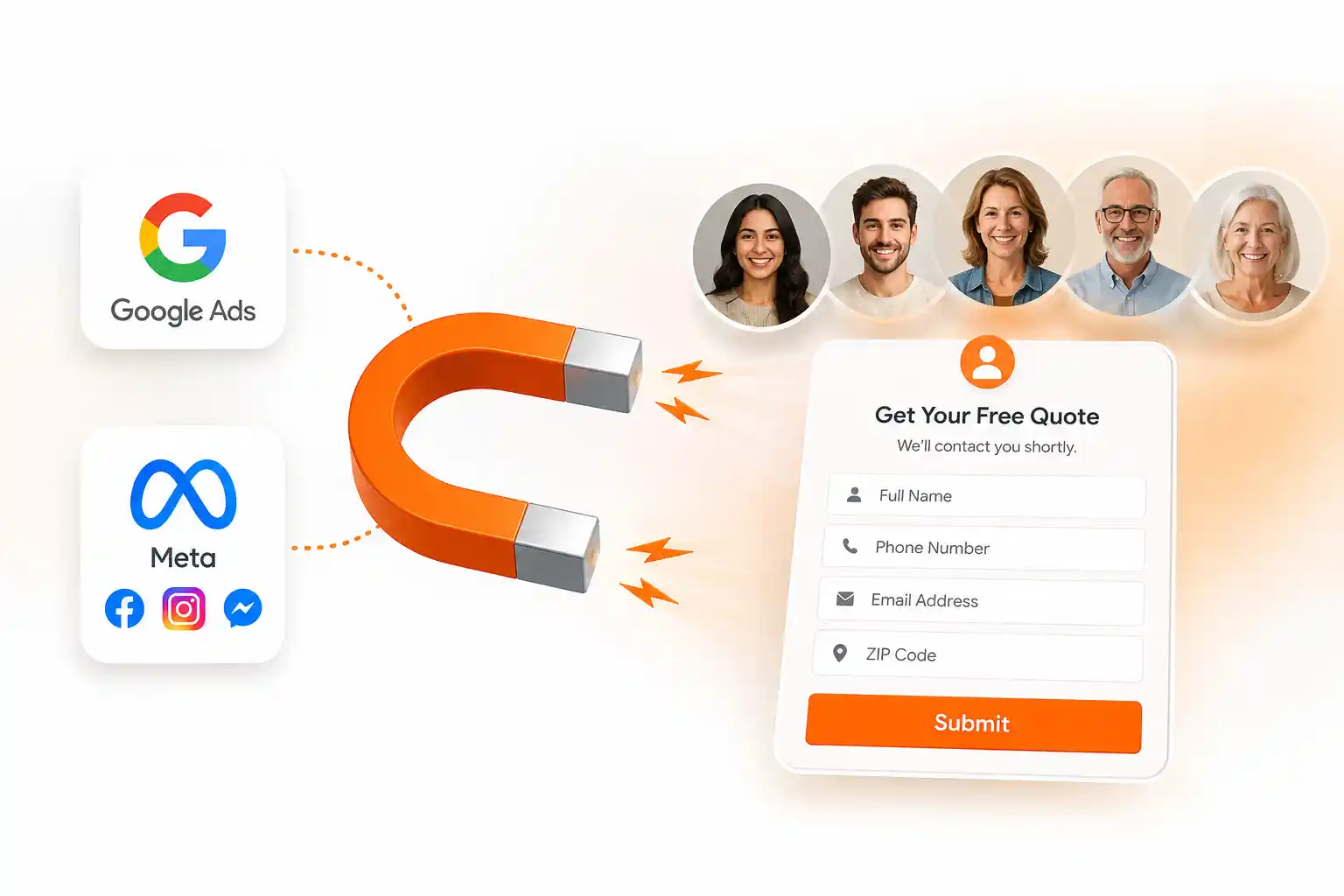
Quick answer: Sorted ROI is a B2C lead generation company built for businesses that sell directly to consumers. We run Done For You Lead Generation across Google, Meta, ChatGPT, and SEO, all pointed at one outcome: Qualified Leads that actually turn into paying customers.
100+
Industries Served
7+
Years of Experience
95%
Client Retention Rate
5K+
Leads Generated
15.75%
Average Lead Conversion Rate
- B2C Lead Generation Services
Sorted ROI’s B2C Lead Generation Services Include
Here’s the part nobody tells you when you Google “B2C lead generation services“: most agencies are only good at one channel.
A PPC agency runs your Google Ads. A social media agency runs your Meta Ads.
Nobody’s actually watching how the two affect each other, and nobody’s building the SEO foundation that keeps working after the ad budget stops.
That’s the gap we close.
We’re not a “set a Facebook ad and check back next month” operation. We’re a team that treats B2C lead generation as one connected system, because a med spa, a roofing company, and a real estate agent all get customers differently, and none of them should get the same templated funnel.
We are the architects of consumer acquisition, and as your B2C lead generation agency, here’s what we bring to the table:
Google Ads Lead Generation (PPC)

Best for capturing people already searching for what you sell, right now.
We bid on hyper-specific keywords to find ready-to-buy consumers.
Meta Ads Lead Generation

Best for creating demand before someone starts searching, using Facebook and Instagram.
We use Meta Ads to skyrocket conversion rates.
ChatGPT & AI Lead Generation

Best for reaching consumers mid-conversation with an AI assistant.
We are pioneers in B2C AI lead generation.
SEO Lead Generation

Best for free, compounding traffic that keeps producing leads long after a campaign budget runs out.
SEO leads often have the highest closing rates.
Local Lead Generation Services
Best for businesses that earn customers from a defined city, zip code, or service radius.
We make your business the obvious choice in your community.
PPC Lead Generation Management

The best and fastest way to acquire a customer.
Our optimized PPC campaigns can increase lead quality by over 60%.
Here’s a sneak peek at how it comes together. We go much deeper into our full process further down this page, but at a glance:
01

Strategy & Offer
We start with your margins and average customer value, then craft a unique offer that resonates with your consumer’s needs or wants.
02

Channel Selection
We pick the channels that match how your ideal customers actually search, scroll, and decide if they want your services.
03

Launch
Our campaigns go live inside your own accounts, on Google, Meta, ChatGPT, or all three, alongside SEO on your website.
04

Lead Qualification
We filter out tire-kickers before they ever reach your phone or inbox.
05

Tracking
Every lead traces back to the exact channel, campaign, and keyword that produced it, so we keep on optimising and lowering cost per lead.
06

Reporting & Scaling
You receive 100% transparent reports showing actual cost per lead, and then we scale what’s actually working.
If you’re comparing us against every other B2C lead generation company out there, here’s our honest pitch: “Take control of your customer acquisition and partner with a true B2C lead generation company that values your return on investment as much as you do.”
Book a free strategy call, and we’ll tell you straight whether a Done For You lead generation setup makes sense for your business right now, or if your budget is better spent elsewhere first.
FAQs For B2C Lead Generation Services
What is a B2C lead generation service?
A B2C lead generation service is a company that finds, attracts, and qualifies individual consumers who are interested in what your business sells, then hands you their contact details so your team can close the sale. For a consumer-facing business (like home services, real estate, dental, med spas, gyms, auto), B2C lead generation means paid ads, SEO, and landing pages built around a single consumer’s buying decision.
Are lead generation companies worth it?
Lead generation worth depends on your budget and your industry. Lead generation companies earn their keep by handling the strategy, tracking, and channel management because most business owners don’t have 15 to 20 hours a week to learn properly. Where it stops being worth it: budgets so small that neither DIY nor an agency can gather enough data to optimize (generally under $500 to $1,000 a month in ad spend). Above that range, a good B2C lead generation agency should save you more in wasted ad spend and missed leads than it costs. The businesses unhappy with lead generation aren’t the ones who tried it properly but the ones who tried it for three weeks and quit right before it started working.
How fast can I start getting leads with Sorted ROI?
After our strategy call, we can go live on paid channels like Google, Meta, and ChatGPT ads within 2 to 7 days, and traffic starts immediately. But meaningful, decision-worthy data on optimising cost per lead shows up after 2 to 3 weeks of consistent ad spend. SEO leads take longer, typically 3 to 6 months for the first real wave, but it keeps compounding for free long after that. Most of our B2C clients run paid and SEO together specifically so paid ads produce leads immediately while SEO builds toward long-term, free lead flow.
- Services Explained In-Depth
Sorted ROI’s B2C Lead Generation Services Explained In-Depth
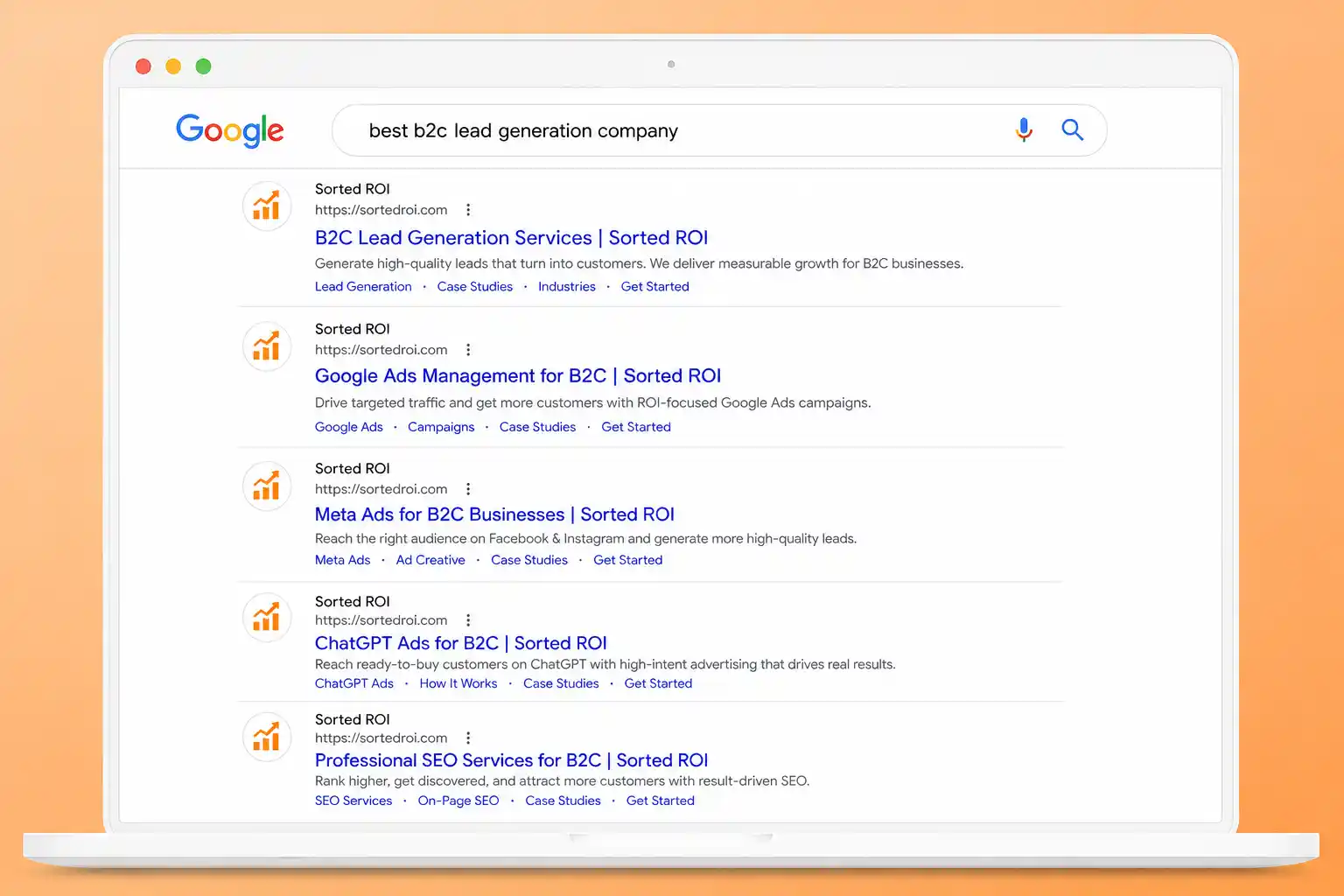
Quick Answer: Our full B2C lead generation services cover Google Ads, Meta Ads, ChatGPT Ads, SEO, local lead generation, landing pages, and lead qualification, all built for businesses that sell to individual consumers. Our goal isn’t traffic or impressions. It’s leads that convert into paying customers, tracked back to the exact channel and campaign that produced them to optimise and lower your cost per lead.
Most people searching “lead generation B2C” picture one thing: running a few ads and waiting for the phone to ring.
That’s a small piece of what actually moves the needle.
Real B2C lead generation means picking the right channels for how your ideal customers actually behave, building pages that convert, qualifying leads before they ever waste your time, and tracking every dollar back to a result you can verify.
A consumer deciding whether to book a dentist or hire a roofer doesn’t shop like a business buyer. They decide faster, on emotion as much as logic, and they’re gone the moment a page loads slowly. That’s exactly why expertise matters: Every channel we run is judged by what it converts into paying customers, not how much traffic it brings.
As a 100% authentic lead generation digital marketing agency, we don’t just “turn on some ads and hope.” We decide which channels earn your budget first, in what order, and why, based on your industry, your margins, and how your actual customers make a buying decision.
Here’s the full breakdown of what’s included in our B2C lead generation services.
Google Ads Lead Generation (PPC)
Search is where the highest buying intent already exists.
I mean, just imagine: someone types “same day AC repair” or “best med spa near me” on Google and your business shows up right on top exactly when they’re ready to act.
We use Google to capture people already looking for your services.
We build tightly themed campaigns around your highest-intent keywords, write ads that match what the user actually searched, and remove negative keywords so your budget never pays for the wrong click.
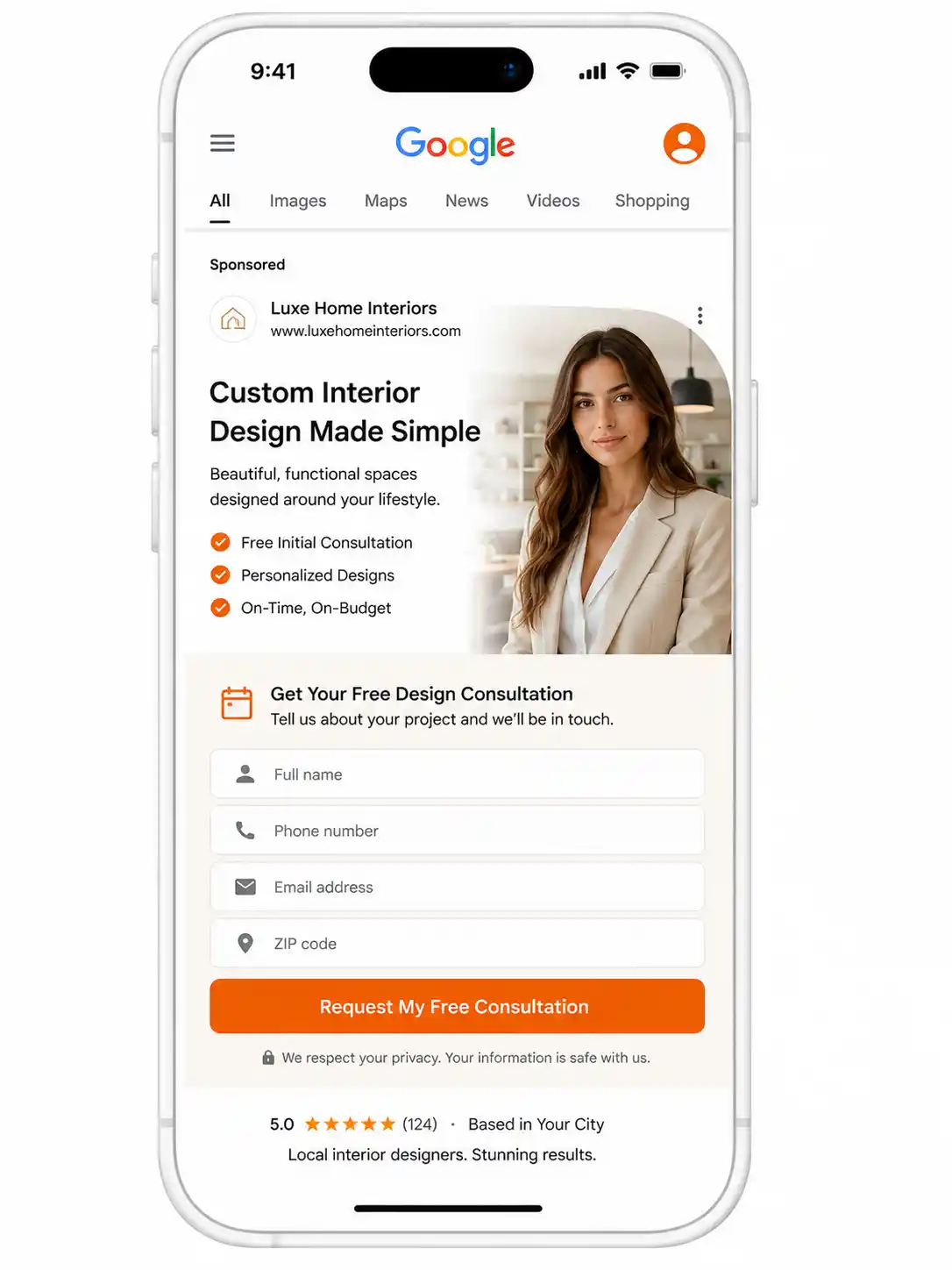
Across all our B2C client accounts in search campaigns, we generate leads at a higher conversion rate than average (Average conversion rate of our leads ~ 15.75%), well above average industry benchmarks. If you want the full breakdown of everything under this channel, our dedicated Google Ads management service page covers it in depth.
Meta Ads Lead Generation
Meta creates the demand and interest in your services.
We build full-funnel campaigns across Facebook and Instagram: Prospecting ads to introduce your business, retargeting ads to bring back the people who almost converted, and lead-form qualification questions so you’re not drowning in unqualified form fills.
Meta is what we use for B2C businesses selling on emotion, before/after results, or visible transformation (med spas, home renovations, fitness) usually win the most leads per dollar, and our active Meta campaigns average a 15.75% lead conversion rate. Our Meta ads marketing agency page goes deep on exactly how we run this channel.
ChatGPT & AI Lead Generation
This is the newest platform for B2C AI lead generation, and most of your competitors haven’t touched it yet.
OpenAI opened ChatGPT to advertisers in 2026, and ads there don’t work like Google or Meta.
There’s no keyword bidding.
Instead, we build “context hints” around the actual conversations your customers have with ChatGPT before they buy; things like “best contractor for a kitchen remodel” or “affordable dentist near me that takes new patients.”
We’ve seen early movers on this channel get cheaper clicks and less competition, the same way early Google and Facebook advertisers did.
If B2C lead generation AI sounds like buzzwords to you, that’s fair because even most marketing agencies are also still figuring it out.
Meanwhile, we’re already running live campaigns. You can see our ChatGPT Ads agency page for the full picture.
SEO Lead Generation
Paid ads stop the moment you stop paying.
SEO and Lead Generation work differently: once you organically rank on top of Google, you keep earning free leads without a daily budget behind it.
We build this through technical fixes, content that matches what your customers actually search, local SEO for map-pack visibility, and authority building, so your business shows up organically for the exact searches that lead to a sale.
SEO is slower to build than paid ads, but the payoff shows up in the numbers: SEO-driven leads easily convert at roughly 20% on average, compared to under 4% for typical paid traffic and under 2% for cold outbound.
SEO lead conversion is often around $30 per lead once a page ranks versus $180 or more through paid channels. More details are available on our professional SEO services page.
Local Lead Generation Services
If your business earns customers from a defined city, zip code, or service radius, local lead generation services matter more than almost anything else on this list.
We set Primary service zones and Secondary service zones around your most profitable areas, excluding regions you can’t service.
We also set up local SEO (Google Business Profile, consistent listings, reviews) on top of paid ads so you show up both in the map pack and in paid results for the same search. This combination is where most of our home services, dental, med spa, and real estate clients see their fastest and cheapest wins.
PPC Lead Generation Management Services
Plenty of businesses come to us already running ads somewhere, just not running them well.
Our PPC lead generation management services start with a full audit: wasted spend, broken tracking, weak Quality Scores, and landing pages that don’t match the ad. Then we rebuild what’s underperforming and manage bidding, budget, and creative on an ongoing weekly basis.
We first fix the leaking bucket rather than trying to fill it faster.
Landing Pages Built to Convert

An ad that promises a specific answer needs a page that delivers on it immediately.
We build dedicated landing pages for every campaign, always matched to exactly what the ad promised, with one clear call to action: a form, a phone number, or a booked appointment.
A great ad with a weak landing page is still a losing campaign, so this is never an afterthought in how we run our B2C lead generation services.
Lead Qualification & CRM Integration
A cheap lead that never answers the phone is more expensive than an expensive lead that closes.
We add qualifying questions to every lead form (timeline, budget range, service needed), set up call tracking so phone leads are attributed correctly, and connect everything to your CRM so no lead falls through the cracks between channels.
This is also the data that we feed back into Google, Meta, and ChatGPT’s own algorithms, so each platform gets smarter about who to target next and, in turn, lowers our cost per lead.
Lead Nurture & Follow-Up Systems

A lead that doesn’t hear back within an hour often becomes a competitor’s customer within a few more hours.
We set up automated first-response texts and emails that go out the moment a form is submitted, so nobody on your team has to be on their heels to notice a new lead came in.
For B2C purchases with a longer consideration window (real estate, financed installs, higher-ticket renovations), we also build a simple nurture sequence: a follow-up a few days later, then again a week out, then a final check-in, so leads who weren’t ready to buy on day one don’t just completely disappear from your pipeline.
Most B2C lead generation agency packages stop at “here’s your lead.” Ours doesn’t, because a lead nobody follows up with fast enough was never really a lead to begin with.
Paid + Organic, Under One Roof

Running Google, Meta, ChatGPT, and SEO through separate, disconnected vendors means nobody’s actually looking at the full picture.
Google Ads captures high demand from people already searching.
Meta creates demand before someone starts searching.
ChatGPT builds trust and relevance in the middle of a conversation.
SEO keeps earning you free leads long after a campaign budget runs out.
Running all four under one strategy also means we can see, in your own data, which keywords and offers convert best on paid before we ever invest months of SEO effort in chasing them organically.
Nothing is a guess, and our clients running two or more channels together typically land a lower blended cost per lead than any single channel alone, since each one is doing a different job for the same buyer.
Why a Lead Generation Specialist Agency Beats a Generic Marketing Agency
Generic agencies often hand B2C lead generation to whichever account manager also handles social media, web design, and email that week.
That might work for basic awareness campaigns, but your leads end up competing for attention with a dozen other unrelated tasks.
We run B2C lead generation services as a specialty, and it shows up directly in the results: Our 95% client retention rate, and accounts we’ve audited from a previous generalist agency typically see cost per lead drop and conversion rates climb easily within the first two reporting cycles, simply from fixing tracking, targeting, and creative that nobody was watching closely enough to catch.
B2C Lead Generation Services FAQs
What’s the difference between B2C and B2B lead generation services?
B2C lead generation targets individual users making a personal buying decision, usually faster, more emotional, and with a much shorter sales cycle. B2B lead generation targets other businesses, often with multiple decision-makers, longer research periods, and higher-value but less frequent purchases. The channels overlap (Google, Meta, SEO all work for both), but the offers, ad copy, and landing pages need to speak to a completely different buyer. A B2C lead generation company like ours is worth hiring because we build campaigns focused on “how does this consumer decide today?”.
Do you offer local lead generation services for small businesses?
Yes, local lead generation is one of the core services we run, especially for home services, dental and medical practices, med spas, real estate, and 100+ other local and service businesses that earn customers from a defined area. We combine service-radius targeting on paid ads with local SEO so you show up in both the map results and paid results for the same “near me” searches.
What’s included in PPC lead generation management services?
Full PPC lead generation management services include account audit, campaign strategy, keyword or audience research, ad copy and creative, landing pages, bid and budget management, conversion tracking, and weekly optimization, across whichever platforms make sense for your business (Google, Meta, or ChatGPT). If you’re already running ads, we start with an audit to find what’s leaking budget before touching your strategy. If you’re starting from zero, we build the full account structure from scratch.
- Our B2C Lead Generation Process
How We Run B2C Lead Generation Services: Our Full Process
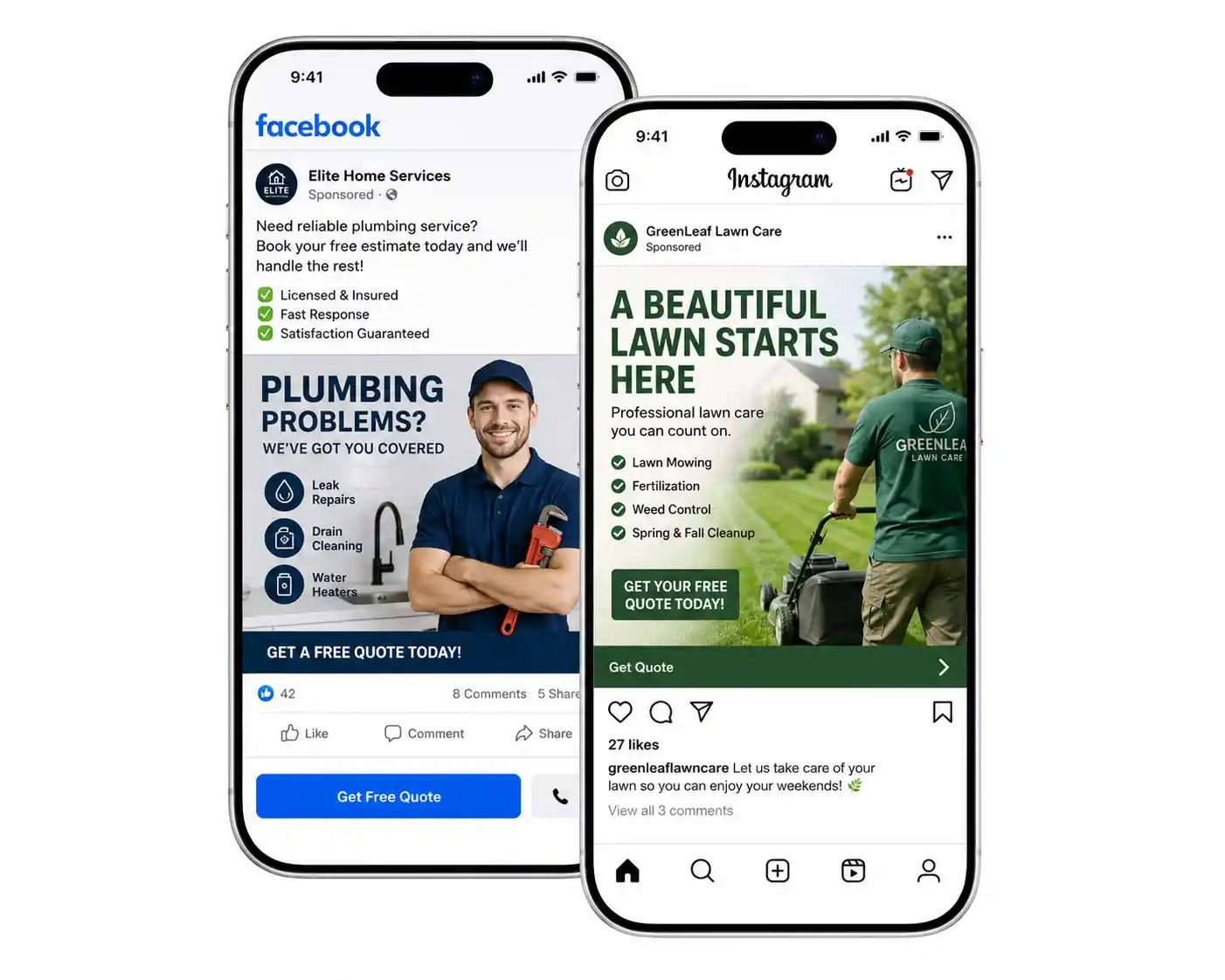
Quick Answer: At Sorted ROI, we run our B2C lead generation services process in thirteen stages, from discovery through Google, Meta, ChatGPT, and SEO setup, to tracking, reporting, and scaling. Every stage maps to how each platform actually works, so nothing about your lead pipeline is a guessing game.
This is the part most agencies won’t walk you through: the real mechanics behind the strategy talk. Here’s exactly how we take a business from zero (or from “leads just aren’t coming in”) to a predictable, multi-channel pipeline.
Step 1: Discovery and Audit
Before we touch a single ad account, we learn your business. Your offer, your margins, your average customer value, your current channels (if any), and what “success” actually means in terms of booked appointments, booked jobs, and closed sales.
If you’re already running ads or have a website, we audit what’s there: campaign structure, tracking accuracy, SEO foundation, and how your current numbers compare to what should be possible with the right marketing strategy.
Most accounts we take over from other agencies are almost always wasting budget somewhere obvious once we actually look closely, whether that’s a landing page that doesn’t match the ad, a tracking pixel that stopped tracking, or a keyword list nobody’s touched since the account was first built.
This stage ends with a written plan specific to your required outcome, so you know exactly what we found and exactly what we’re proposing before a single dollar moves.
Step 2: Competition and Market Analysis
Before we pick a channel, we look at who’s already winning your customer’s attention: which competitors are running paid ads, and where they’re weak- a bad landing page, a slow site, an unmanaged review profile.
We prefer to find that gap before launching a single ad to save you a month of ad spend on expensive guessing.
Step 3: Marketing Channel Selection
We don’t start every B2C business with the same channel.
An electrician with emergency calls needs Google Search Ads first, because someone with a burst fuse is searching right now.
A med spa selling a visible, emotional transformation gets more out of Meta; their buyers need to see the result before they want it.
A business in a new or less-searched category can get more early traction from ChatGPT, where competition is still low.
A real estate agent or a higher-ticket home improvement company should have at least 2 channels working together, since their buyer researches for weeks across multiple platforms before ever filling out a form.
Here’s a simple way to think about it: Google meets a buyer who already knows what they want. Meta introduces your business to a buyer who doesn’t know they want it yet. ChatGPT meets a buyer in the middle of solving a problem, mid-conversation, before they’ve decided where to look next.
As your lead generation consultancy, this is the first real decision we will make together, based on your numbers, your customer’s actual buying behavior, and your required outcome.
Step 4: Google Ads Setup for B2C Lead Generation
For businesses starting with Search ads, we build campaigns around high-intent keywords that signal someone is ready to book an appointment or buy today, structure tight ad groups around a single theme each, and write ads with a specific offer and a dedicated landing page.
We focus on keywords like “24/7 Emergency Plumbing, Booked in Minutes” to earn a booked job rather than keywords like “Professional Plumbing Services” to earn just a click.
We set primary and secondary geographic zones for local businesses, exclude the areas we can’t service, and build a negative keyword list before launch so budget is never wasted on searches that were never going to convert.
Step 5: Meta Ads Setup for B2C Lead Generation
For businesses that benefit from creating demand rather than just capturing it, we build full-funnel Meta campaigns: prospecting creative that introduces your business to someone who’s never heard of you, retargeting for the people who almost converted, and lead forms with qualifying questions built in from day one so a cheap lead doesn’t turn into an expensive waste of your team’s time.
Our main focus is on creative production, as it is the main engine here, since Meta’s algorithm rewards fresh, varied creative and silently punishes accounts that go stale after running the same three ads for a month straight.
Step 6: ChatGPT & AI B2C Lead Generation Setup
This is where B2C lead generation AI actually gets built.
We map the real conversations your customers have with ChatGPT before they buy, then build context hints and benefit-focused ad copy around them.
Since this channel is still new, competition is lower, and clicks are cheaper right now than they’ll likely be in a year once every competitor in your category catches on.
For AI B2C lead generation specifically, being early is most of the advantage; the same edge early advertisers had on Google in the early 2000s and on Facebook a decade later.
Step 7: SEO Foundation for B2C Lead Generation
While paid channels produce leads immediately, we start SEO in parallel because it’s the only channel that gets cheaper over time instead of more expensive.
SEO and Lead Generation work together through technical fixes to make sure your site can actually be found, content built around real search intent instead of guesswork, local SEO for visibility on “near me” searches in maps, and authority building that earns trust with both search engines and AI answer tools.
This won’t produce leads in week one, but by month six, it’s often producing some of the cheapest and highest-converting leads in the entire account, and unlike paid ads, it keeps producing them even in a month you decide to pause everything else.
Step 8: Landing Pages and Offer Build
Every campaign, regardless of channel, sends traffic to a dedicated landing page built around one specific offer and one clear CTA.
We never send paid traffic to a generic homepage.
Our landing page delivers exactly what the ad promised, loads fast, and makes the next step (call, form, or booking) clearly obvious within a few seconds.
Step 9: Tracking and Lead Qualification Setup
We implement conversion tracking before a single dollar of ad spend goes live: Google’s conversion tag, Meta Pixel and Conversions API, ChatGPT’s native pixel, and GA4 across all of it.
For phone-based businesses, we add call tracking so a booked job is attributed to the exact channel and campaign that earned it.
Lead forms get qualifying questions (timeline, budget, service needed) built in, so your team spends time on real prospects, not tire-kickers.
Step 10: Launch Campaigns
Campaigns go live inside accounts you own, not ours.
This matters more than it sounds: if your login and conversion history live inside an agency’s own account, switching agencies later means starting over from zero data.
Early weeks of ad launch get daily attention: watching for delivery issues, pausing anything clearly underperforming, and confirming tracking is capturing what it should before we make any real optimization decisions based on numbers that might not even be accurate yet.
Step 11: Cross-Channel Reporting and Optimization
You get one clear report covering every active channel: cost per lead, lead-to-close rate (wherever trackable), and which specific channel and campaign produced which result.
We compare platform-reported numbers against what actually happened in your business, because a dashboard can only tell you what it thinks it caused, not what your bank account shows.
Our recurring loop for optimization: Pause weak keywords and ad variations, refresh creative before it fatigues, chase new SEO opportunities as they open up, and reallocate budget toward whichever channel is producing the cheapest, highest-quality leads that month.
Step 12: Cross-Channel Message Match
A consumer who sees your Meta ad, then searches your business name on Google, then asks ChatGPT about you, should get one consistent story, not three different offers from three disconnected campaigns.
We keep your core offer, pricing message, and proof points consistent across every channel, while still adapting the format and tone to fit how each platform actually works: a benefit-focused, conversational line for ChatGPT, a visual, emotional hook for Meta, and a direct, search-matched headline for Google.
Consistency here builds trust faster than any single ad ever could on its own.
Step 13: Scaling What Works
Once we know which channels and offers are actually producing paying customers, we scale budget deliberately, without resetting a campaign’s learning phase, and shift budget away from whatever isn’t earning its keep.
This loop repeats every month for as long as we work together.
Why This Order Matters
Skip the discovery step, and you build a strategy on a guess instead of your actual numbers.
Skip competitive analysis, and you spend weeks re-learning what a two-hour audit of your market would have told you on day one.
Skip proper tracking, and every “optimization” after that is just a guess dressed up as data.
Run every channel at once with no sequencing, and you spread a limited budget too thin to learn anything useful from any of them.
This is why a rushed B2C lead generation company that jumps straight into “let’s run some ads everywhere” usually underperforms one that spends the first couple of weeks on discovery and tracking.
It feels slower at first.
It moves faster by month two, because every decision after that is built on real data instead of a hunch, and it’s the same reason we won’t launch a fourth channel for a client in week one, even if a client asks us to.
Ongoing Process, Not a One-Time Project
None of the thirteen steps above are a one-time setup. B2C lead generation is a loop: audiences fatigue, keyword costs shift, and SEO content needs updating as search behavior evolves. Every account gets a dedicated strategist, not a rotating cast of junior account managers, which is usually the difference between cost per lead that keeps dropping month over month and an account that plateaus the moment setup ends. It’s a big part of why our average client retention sits at 95%.
B2C Lead Generation Process FAQs
Do you really use ChatGPT and AI for B2C lead generation?
Yes. We run live, paid campaigns inside OpenAI’s Ads Manager, not just “AI-optimized” versions of Google or Meta campaigns. Our B2C AI lead generation through ChatGPT works on conversational context, which means a different setup process entirely: context hints and benefit-focused copy instead of a hard sell. It’s a genuinely new channel, and most businesses aren’t running it yet, which is exactly why it’s worth testing now.
Which platform generates the best B2C leads: Google, Meta, ChatGPT, or SEO?
It depends entirely on your business and your customer’s buying behavior. Google wins for anything with obvious or urgent search intent (emergency repairs, “near me” searches). Meta wins for visible, emotional, or aspirational purchases (travel companies, home transformations, fitness). ChatGPT works well right now for almost any B2C category, simply because competition is still low. SEO wins on cost per lead over time, once it’s built. Most of our clients end up running two of these channels rather than picking just one, because each channel reaches a slightly different version of the same buyer.
How do you make sure the leads are actually qualified?
We build pre-qualifying questions into every lead form (timeline, budget range, specific service needed), use call tracking so phone leads aren’t a mystery, and route everything into your CRM so nothing slips through. We also feed this data back into each ad platform’s own targeting algorithm, so Google, Meta, and ChatGPT get better at finding more people like your actual best customers, and not more people who just scroll through.
- DIY To Generate Leads
How to Generate B2C Leads Yourself: The Complete DIY Guide
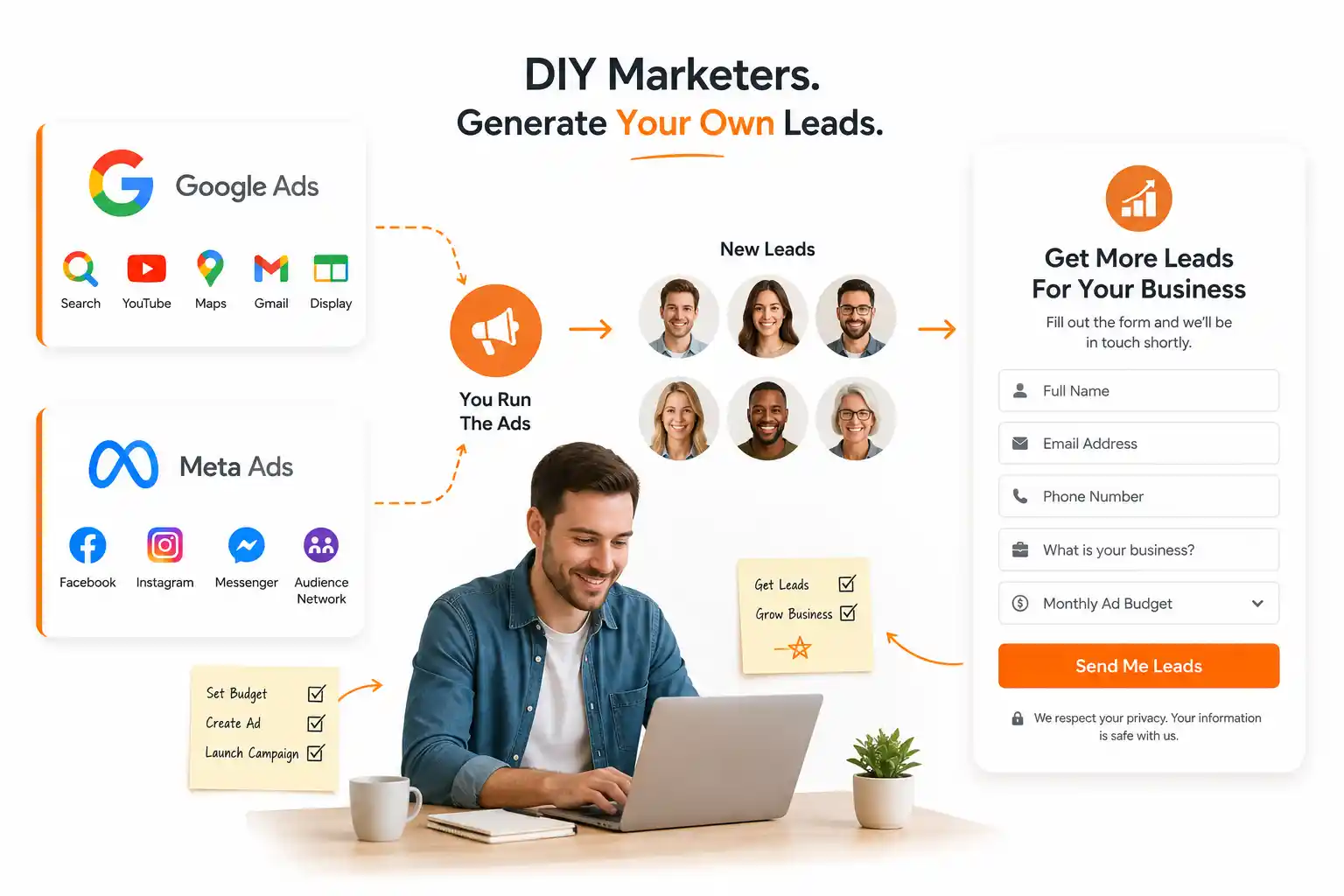
Maybe you want to run this yourself first. We respect that.
If you’d rather have a B2C lead generation agency handle this for you, book a strategy call and skip the rest of this guide.
But if you want to learn how to generate leads for a small business yourself, or just want to understand the moving parts before you hire anyone, here’s everything you need, in the right order.
Quick Answer: DIY B2C lead generation means defining your ideal customer, choosing the right channel for how they actually find your services, building a landing page and offer that converts, tracking every result before you spend real money, and quickly following up with every lead that comes in. Skip any one of these, and you’ll spend money without knowing why it didn’t work.
Almost every DIY effort that is unprofitable is missing one specific piece from this list, not all of them, and it’s rarely obvious which one until the whole process is laid out step by step like this.
Step 1: Understand What Makes B2C Lead Generation Different
B2C lead generation targets individual consumers making a personal decision.
A consumer usually decides faster, buys on emotion as much as logic, and researches less formally than a B2B buyer comparing vendors for months.
This means your ads, offers, and landing pages need to hit an emotional or urgent trigger fast.
Step 2: Define Your Ideal Customer
“Homeowners” isn’t specific enough. “Homeowners in [city] whose water heater just failed and need same-day service” is.
Write down: who they are, what triggers them to search for your services, what they’re afraid of (getting overcharged, hiring someone unreliable), and what would make them trust you enough to hand over their phone number.
This single exercise shapes every decision after it: which channel to use, what your ad should say, and what your landing page needs to prove.
A useful way to stress-test this: if you can’t finish the sentence “My ideal customer searches for us the moment ___ happens” or “My ideal customer starts wanting this the moment they see ___,” your targeting probably isn’t specific enough yet to write a strong ad around, no matter which channel you eventually pick.
Step 3: Pick Your Channel (Google vs. Meta vs. ChatGPT vs. SEO)
Don’t try to run all four at once with a small budget. Pick based on how your customer actually behaves:
- Google Ads — best if your customer searches when they need you (emergency repairs, “near me” searches, anything urgent). This is usually the fastest path to a first lead.
- Meta Ads (Facebook & Instagram) — best if your customer doesn’t know they want you yet (visible transformations, aspirational purchases, anything sold on a before/after or an emotional hook).
- ChatGPT Ads — best if you want lower competition and cheaper clicks right now, since most small businesses haven’t touched this channel yet. Works well across almost any B2C category while it’s still early.
- SEO — best as a long-term addition alongside whichever paid channel you pick first. It’s slower, but it’s the only channel that gets cheaper the longer you stick with it.
Tip: If your budget is genuinely tight, pick one paid channel and run it properly instead of spreading a small budget across three platforms that each get too little to learn from.
Step 4: Set a Realistic Budget by Channel
There’s no universal minimum, but a budget too small to gather data teaches you nothing. As per our expertise, you can use the stats below as a rough guide:
- Google Ads: aim for enough daily budget to afford at least 15 to 20 clicks a day in your category, so you gather real signal within two to three weeks.
- Meta Ads: Meta’s own guidance points toward roughly 50 conversions per ad set to exit the platform’s learning phase. For lower-volume, high-ticket services, optimize for the lead form itself rather than waiting on a rarer event, and give the account a longer runway before judging it.
- ChatGPT Ads: daily budgets under $50 generate too little volume for the algorithm to learn from. A smart starting test is $100 to $300 a day for the first two weeks, or four to five ad groups at $25 a day each if cash is tight, killing the losers after one full week.
- SEO: budget time, not just money. A genuinely useful, well-optimized page usually takes 1-2 days once you include research, writing, and on-page work, and rushing this is the most common reason DIY content underperforms.
Tip: A campaign that runs out of budget by mid-morning every day never gets a fair chance to prove itself. Fewer, properly funded campaigns beat several underfunded ones every time.
Step 5: Build a Landing Page That Converts
Never send ad traffic to your homepage.
Build one page per offer, and make sure it does three things in the first few seconds: state what you offer, who it’s for, and what to do next.
A converting B2C landing page usually includes:
- A headline that matches exactly what the ad promised.
- One clear call to action (a form, a phone number, or a booking calendar), not five competing buttons.
- Real trust signals: reviews, before/after photos, licenses, years in business.
- A fast load time. A slow page loses visitors before they ever see your offer.
Step 6: Create an Offer People Actually Want
“Contact us for a free quote” is weak.
It’s been used so many times it barely registers anymore.
Stronger offers are specific and remove risk: “Free AC inspection, this week only,” “See your new smile before you commit, free 3D preview,” “Get a same-day quote, no obligation.” Specificity and urgency both do real work here.
For businesses with a longer consideration window (real estate, high-ticket home renovation), a genuinely useful lead magnet (a cost guide, a checklist, a calculator) can capture a lead who isn’t ready to buy today but will be soon.
Step 7: Build Trust Signals Into Everything
A consumer deciding whether to let you into their home, handle their money, or work on their body needs a reason to believe you before they’ll hand over a phone number.
Put real proof everywhere it fits naturally: recent review counts and star ratings, before/after photos wherever relevant, licenses and certifications, years in business, and real photos of your actual team instead of stock imagery.
This matters on your landing page, in your ad creative, and in your ad copy itself. A line like “Trusted by 500+ local families” does more work than any adjective describing how professional you are.
Step 8: Write Ad Copy That Actually Converts
Whatever platform you’re on, the same principles hold.
Lead with the specific value, not a slogan: “Get a Same-Day Roof Inspection” beats “Quality Roofing Services” every time, because it tells a reader exactly what happens if they click.
Write several genuinely different angles instead of five versions of the same line: one built around price, one around speed, one around a guarantee, one around a specific use case.
A single “best” ad wears out fast, especially on Meta and ChatGPT, both of which reward variety and quietly punish repetition. And always match your ad’s promise to your landing page.
An ad that promises “Free Quote in 24 Hours” but lands on a generic homepage breaks the promise before the visitor even finishes reading it.
Step 9: Set Up Tracking Before You Spend a Dollar
Do this before launch, not after. At minimum:
- Install the tracking pixel or tag for whichever platform you’re using (Google tag, Meta Pixel, ChatGPT’s pixel).
- Set up a clear “primary conversion” (a form fill, a call, a booking), not a click or impression.
- If leads close by phone, add call tracking so those calls don’t disappear as untracked numbers.
- Connect Google Analytics 4 for a full picture beyond just the ad platform’s own dashboard.
Skipping this step means every decision you make afterward is just a guess.
Step 10: Launch on Your Chosen Channel
For Google Ads, start with Search campaigns around high-intent keywords (specific, urgent phrases, not single broad words), and build a negative keyword list from day one.
For Meta Ads, use the Leads objective, since it’s built specifically for capturing name, phone, and enough detail to know if someone’s worth calling back, and budget enough to gather real data before judging results.
For ChatGPT Ads, build “context hints” around the actual problem-solving conversations your customers have and write benefit-focused copy instead of a hard sell.
For SEO, start with your Google Business Profile if you’re a local business, since that alone often produces the fastest visible movement of anything on this list.
Step 11: Qualify Leads With Smart Forms
Add two or three qualifying questions to every lead form: timeline, budget range, and specific service needed.
This single change filters out a large share of unqualified form fills before they ever reach your phone, and it’s one of the highest-leverage, lowest-effort fixes in all of DIY PPC lead gen.
Step 12: Follow Up Quickly
Speed to lead is one of the most well-documented findings in all of sales research: contacting a new lead within the first 30 minutes dramatically increases the odds of reaching them and closing the sale, compared to waiting for 2 hours.
Every hour after that, your odds of converting that lead keep dropping.
If you can’t answer instantly, set up an automated text or email that goes out the second a form is submitted, confirming you got it and telling them when to expect a call. It’s a small fix that keeps a warm lead from going cold, or worse, calling your competitor instead.
Step 13: Nurture the Leads Who Aren’t Ready To Buy Yet
Not every lead converts on day one, especially for higher-ticket B2C purchases like real estate, renovations, or financed installs.
So build a simple follow-up sequence: a text or email a few days later, a helpful reminder a week after that, and a final check-in a few weeks out.
Most DIY efforts only follow up once, then give up on a lead who might have converted on attempt number four.
Step 14: Track Your Numbers Weekly
At minimum, check weekly: cost per lead, how many leads actually became customers, and which channel or campaign each one came from.
Compare month over month, not day over day.
B2C lead generation, especially SEO, is noisy in short windows and much clearer over a 2- to 3-month period of real data.
Step 15: Test, Measure, and Iterate
Only change one variable at a time for testing.
If you adjust your offer, your targeting, and your ad creative all in the same week, you won’t know which change actually caused the result you’re seeing, good or bad.
Run a test long enough to gather real data (at least a week, ideally two to three), then make one deliberate change and measure again.
This is slower than changing everything at once, but it’s the only way to actually learn what’s working instead of guessing after every iteration.
Keep a simple log: what you changed, when, and what happened to cost per lead and lead quality afterward. Six months in, that log becomes more valuable than any single campaign, because it’s the closest thing you’ll have to your own private playbook for what actually works for your business.
Common DIY Mistakes That Kill Lead Quality
- Sending every visitor to your homepage. It breaks the specific promise your ad made and tanks your conversion rate.
- One offer, no variations. A single “best” offer fatigues quickly, especially on Meta, and needs fresh versions to keep performing.
- No qualifying questions on lead forms. This is the single fastest way to end up with a phone full of leads that never answer or were never really interested.
- Slow follow-up. A lead who doesn’t hear back within minutes often becomes a competitor’s customer within a few hours.
- Judging results after 3 days. Give a real campaign at least 2 to 3 weeks and enough data before deciding it “doesn’t work.”
- Running every channel at once with a small budget. Spreading $500 across four platforms teaches you less than spending it all on one.
- Treating SEO like a paid channel. SEO takes months to build. Expecting results in the first week is the most common reason DIY SEO efforts get abandoned right before they were about to pay off.
- Ignoring what your own data is telling you. It’s tempting to keep running an ad you personally like even after the numbers say it’s underperforming. The numbers are always right, even when they’re not what you hoped to see.
DIY vs Done For You Lead Generation: Which One Fits You?
DIY makes sense if: you have a genuine 10 to 15 hours a week to learn the platforms properly, your budget is modest enough that a mistake is a cheap lesson, and you actually enjoy this kind of work.
Done For You lead generation makes sense if: you’d rather spend your time running your business than reading four different platforms’ help docs, your budget can absorb a real testing phase, and you want that phase optimized by people who do this daily, or you’ve tried DIY and hit a ceiling on time, tracking, or creative volume.
Neither path is wrong. The honest, recurring pattern we see, and one that shows up constantly in small business communities on various forums, is that people who regret lead generation aren’t usually the ones who tried DIY or the ones who hired an agency. They’re the ones who quit either within a few weeks, right before it started working.
There’s also a middle ground worth naming: plenty of business owners run one channel themselves (usually Meta, since it’s the most visual and forgiving to learn) while handing off the more technical channels, like Google Ads bidding or SEO’s technical side, to a specialist. That split can work well if you’re genuinely enjoying the hands-on part and just want expert help where the learning curve is steepest.
One more honest way to decide: price your own time. If 10 to 15 hours a week is worth less to you than what an agency charges, DIY is the better trade. If it’s worth more, then it’s definitely better to hire a lead gen agency.
How to Evaluate a B2C Lead Generation Agency (Ours Included)
Whether you’re comparing us against another B2C lead generation company or vetting someone else entirely, the same questions apply, and a confident agency should answer every one of them without dodging or getting defensive.
Ask any agency you’re considering:
- What’s your actual process for channel selection and testing? Vague answers here are the biggest tell.
- Can I see a real case study, from starting numbers to ending numbers? No specifics, no deal.
- Have you worked with businesses in my industry before? An agency that already knows your trade knows what offers and objections actually work.
- Do I keep full ownership of my ad accounts and data? You should never be locked out of your own accounts, ever, even after you leave.
- What’s your contract length? Long lock-ins with vague deliverables are a red flag. Month-to-month, or a 90-day initial ceiling, is reasonable.
- Will you guarantee a specific number of leads? Be skeptical if they say yes before ever auditing your business. No legitimate agency can promise a fixed number.
DIY B2C Lead Generation FAQs
How to generate leads for a small business on a tight budget?
Pick one channel instead of spreading a small budget across several. For most local B2C businesses, that’s Google Ads if customers search for you urgently, or Meta if you’re selling something visual or emotional. Add qualifying questions to your lead form, follow up within minutes, and give the campaign at least 2 to 3 weeks before judging it. SEO is worth starting in parallel since it costs time rather than ad spend, but treat it as a long-term addition, not your only source of leads early on.
How much should a small business budget for B2C lead generation?
There’s no universal number, but a budget that can’t generate at least 15 to 20 clicks a day on paid channels rarely produces enough data to learn from. Latest published benchmarks put blended cost per lead anywhere from under $50 for high-volume consumer categories like home services and ecommerce, up to $200 or more for higher-ticket purchases like real estate or financed installs, so your real budget depends heavily on what a new customer is worth to you.
What’s the fastest lead generation channel for beginners?
Google Search Ads, if your customers search for you when they need you (plumbing, HVAC, legal, dental emergencies). It captures demand that already exists instead of trying to create it, which is a more forgiving starting point for someone new to paid advertising than Meta or ChatGPT, both of which require getting your creative and messaging right before demand shows up at all.
Should I do B2C lead generation myself or hire an agency?
If you genuinely have the time to learn multiple platforms and a budget that can absorb a learning curve, DIY is a completely reasonable place to start, and this guide covers what you need. If your time is better spent on running your business, or the cost of a slow start is high for you, a B2C lead generation agency like ours will get you to consistent results faster. You can book a free strategy call with us if you’d rather skip the learning curve entirely.
What tools do I need for DIY B2C lead generation?
At minimum: Google Ads Manager and Meta Business Suite (both free to open an account), the Google tag and Meta Pixel for tracking, Google Analytics 4, and a simple CRM or even a shared spreadsheet to track leads and follow-up status. If you’re adding ChatGPT Ads, you’ll also need an OpenAI Ads Manager account. None of these have a real cost barrier to start; the real cost is the ad spend itself and the hours it takes to run them properly.
- White Label B2C Lead Gen
White Label B2C Lead Generation Services for Other Agencies
Quick answer: Sorted ROI runs white label B2C lead generation services for agencies that need real, multi-channel execution without hiring an in-house team, delivered under your brand with client-ready reporting.
Some of the demand for our B2C lead generation services doesn’t come directly from business owners. It comes from other marketing and creative agencies that need Google, Meta, ChatGPT, or SEO execution for their own B2C clients, without building an in-house team across four different platforms from scratch.
If that’s you: Sorted ROI offers white label B2C lead generation under your brand, with client-ready reporting and no direct contact between us and your client unless you want it that way.
Running one channel well for a full client roster is a specialty. Running four (Google, Meta, ChatGPT, and SEO) well, across every client on your books, is a different scale of operation entirely. We handle the account work quietly in the background while you keep full ownership of the client relationship and the reporting that goes out under your name.
This works well for agencies that already own the strategy layer and simply need a dependable lead generation consultancy for execution, whether that’s one overflow client or your entire B2C book of business.
Frequently Asked Questions About B2C Lead Generation Services
Below are the most common questions we get about B2C lead generation services: cost, ownership, contracts, and what actually separates a real agency from a risky one, answered directly, without the sales pitch.
A B2C lead generation company plans, builds, and manages campaigns across the channels where individual consumers actually search, scroll, and decide, typically Google, Meta, ChatGPT, and SEO. A company that covers strategy, channel setup, ad copy, landing pages, tracking, and lead qualification, then reports back with cost per lead and lead-to-close rate, not just clicks and impressions.
On average, single channel B2C lead generation services cost ~ $999/mo.
At Sorted ROI, our individual channel services start at $599/mo for Google Ads, Meta Ads, ChatGPT Ads (plus ad spend for all 3 channels), and SEO. We charge only flat monthly retainers and never a percentage of ad spend.
However, our bundled B2C lead generation package is exactly quoted on the strategy call and it typically depends on how many channels you run together and your total ad spend across them. Ad spend itself is always separate and paid directly to the ad platforms (Google, Meta, or OpenAI), and never to us.
You own every lead, always. Leads flow directly into your CRM or inbox in real time(wherever you want). We generate exclusive leads for you and we never resell, share, or redistribute leads generated for your business to anyone else.
Yes. Unlike shared-lead marketplaces that sell the same consumer’s information to 50 competing businesses at once, every lead we generate through your B2C lead generation services campaign comes directly to you and only you.
We work across 100+ industries, with the deepest experience in home services (plumbers, electricians, HVAC, roofing, solar), real estate and mortgage, dental and medical practices, med spas, gyms, schools, auto detailing, and other local, service, and brick-and-mortar businesses. If your business earns customers from a defined service area, or sells something people actively search for or scroll past, there’s a good chance we’ve already run something similar.
Qualification is what turns a cheap click into a lead worth answering the phone for. Every form and call gets filtered before it reaches you, so the time you or your team spends on the phone goes toward people who are actually ready to buy, not toward re-explaining your pricing to someone who was just browsing.
We don’t lock clients into long-term contracts. Month-to-month is standard, sometimes with a short initial term (never more than 90 days) so a channel has enough runway to gather real data before either of us judges it.
We connect directly to whatever CRM or booking system you already use, so leads land where your team already works instead of forcing you onto new software. If you don’t have a CRM yet, we can recommend a simple option based on your industry and volume.
We’re paid flat monthly retainers for the work, never a percentage of your ad spend that quietly grows more expensive as you scale, and you always own 100% of your own ad accounts and data. We bring 7+ years of media buying experience across 100+ industries, a 95% client retention rate, a way higher than average lead conversion rate, and we’re already running live campaigns on top ad platforms including Google, Meta, and ChatGPT.
No legitimate agency can promise a fixed number of leads before ever auditing your business, and it’s a red flag if one does. What we can promise is a tested process across four channels, transparent reporting, and realistic, industry-specific expectations set on your strategy call, which is a far more honest indicator of results than a number pulled out of thin air.
Initial setup and launch happen fast (within 7 days easily). What matters more in the long-term is: cost per lead decreases within the first 60 to 90 days as we cut what’s not converting and double down on what is, then you will have a predictable number you can plan a sales team around. SEO adds a second strategic layer on top of that: slow to start but cheaper every month it keeps ranking after.
Done With Reading…?. Want To Get Straight To Business?
Tell us about your business, and we’ll get back to you with complete details about what’s currently working best in your industry and what we can do to grow your business.
Take the initiative.
Affordable Pricing. Flexible Agreements. You own the data.