- Meta Ads for Architects Agency
Facebook Ads for Architects: Turn Visual Ads into Signed Projects
Sorted ROI‘s Facebook Ads for Architects turn visual attention into qualified project enquiries.
No commission
Exclusive leads
Transparent ad spend
Who are we? What do we do?
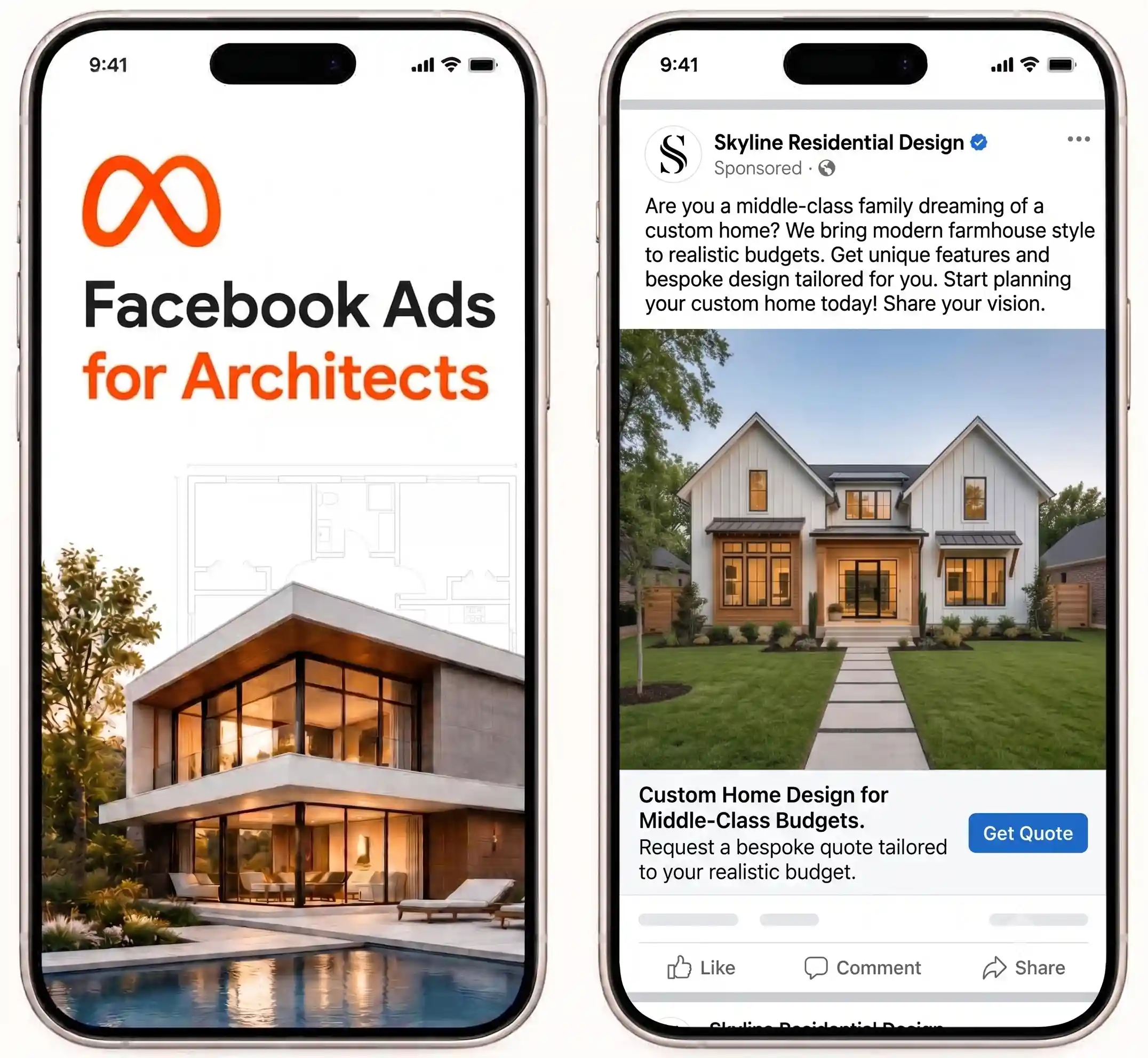
Quick answer: Sorted ROI is a Facebook Ads agency for architects and a Meta Ads company for architects. We plan, build, and manage Facebook and Instagram campaigns for residential, commercial, and specialist firms. We handle strategy, creative, audiences, tracking, and budget inside your own Meta Business Manager.
- Facebook Ads Services for Architects
Sorted ROI’s Facebook Ads for Architects Services Include
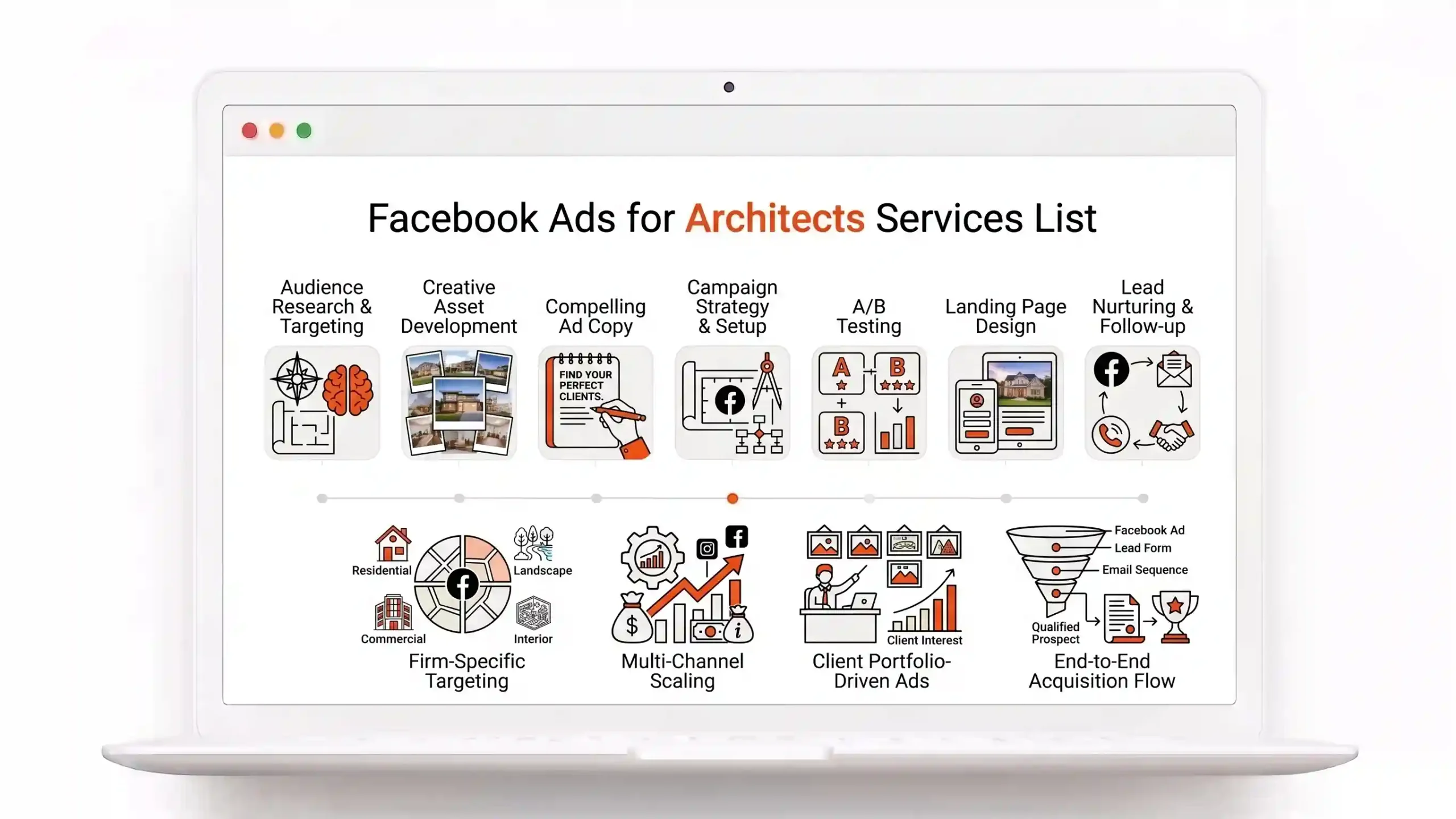
Quick answer: Sorted ROI’s Facebook Ads for Architects services cover everything from audit to conversions with transparent reporting. Every item is built to turn a scroll into a real project conversation.
Picture this: A homeowner saw three of your completed projects and liked them, then filled out a form that asked for budget, timeline, and lot location, is already pretty interested in hiring your firm. All you now need to do is call and close them.
Our job is to put your firm in front of those people and filter out tire-kickers.
Our Full Service List
Here is every service that sits under Facebook Ads for Architects at Sorted ROI.
Architecture audience & demand audit
Meta Business Manager setup (you own it)
Housing Special Ad Category and policy review
Offer and funnel design
Audience architecture (residential & commercial)
Custom audiences and lookalikes
Creative production (portfolio, Reels, carousels)
Ad copy for architecture decision-makers
Landing Page & Lead form
Pixel, CAPI, and conversion tracking
Geo targeting and radius control
Retargeting
A/B Testing (Creative & Audience)
Creative refresh and ad fatigue prevention
Ongoing Optimization
Monthly reporting (enquiries and CPL)
1. Architecture Audience & Demand Audit
We do not guess who you should advertise to.
We start by asking who you actually want to work with.
Custom homes? Additions? Commercial interiors? Schools? Multifamily?
We study your past projects, service area, and real local competitors in the Meta Ad Library before spending a dollar. This tells us which project type we should lead with and where the gap is.
We also look at your current Meta Ads account if you have one.
2. Meta Business Manager Setup
We set the ad account up in your Business Manager. You own the Page, the ad account, the Pixel, and all the data. We work as admins.
If you already have a Meta Ads account, we do not start from zero. History is useful, and we use it.
3. Housing Policy and Special Ad Category Review
This is the part a generalist agency misses, and it is how architecture ads get rejected.
Meta’s housing ad policy says a housing ad is one that “promotes or directly links to a housing opportunity or related service,” and Meta locks age, gender, and ZIP code targeting, kills lookalikes, and forces a 15-mile radius on housing ads, and that is disastrous for a regional residential studio that gets projects from eight surrounding towns.
So, most of our Facebook Ads for Architects campaigns are never declared as Housing, and we always review copy, creative, and landing pages before launch.
4. Offer and Funnel Design
A pretty photo is not an offer. “We do architecture” is not an offer.
An offer for Facebook lead generation for architects is a specific next step a real buyer will take:
- Book a 20-minute project consultation
- Request a project review
- Call and ask for a custom-home process guide
- See three similar projects in your town
We design the funnel around your project value.
5. Audience Architecture (Residential & Commercial)
Residential clients and commercial clients are completely different.
A couple planning a $1.2M custom home is scrolling Instagram at 9 pm looking at kitchens, and a developer looking for an architect is on Facebook between meetings, saw your project, clicked, but needs a retargeting ad for more persuasion.
We build an audience in your area based on: homeowners, renovation-interest audiences, past site visitors, and lookalikes of your best clients.
6. Custom Audiences and Lookalikes
Your best Facebook audience is people who already know you.
We build custom audiences from previous qualified interest and a few more metrics.
For lookalikes, we wait until we have enough qualified enquiries because a lookalike of junk leads produces junk leads.
7. Creative Production (Portfolio, Reels, Carousel)
We produce creative in the formats Meta strongly prefers:
- Single image of a finished project with one solid hook
- Before/after carousels for remodels
- Project walkthroughs
- Reels with process: sketch → model → final design
- Carousel case studies with testimonials
- Founder-on-camera ads (if you’re comfortable)
We use your work, cropped for Feed (4:5), Stories/Reels (9:16), and landscape where needed.
8. Ad Copy (for Architecture Decision-Makers)
Ad Copy for Facebook Ads for architects has one job: attract decision-makers and filter tire-kickers.
Our ads make the right person lean in, and the wrong person scroll on.
We don’t write “Award-winning, client-focused, innovative design solutions.”
That sentence describes every firm on the internet and none of them.
Direct beats clever. We write direct.
9. Landing Page & Lead Form
If the ad says “custom home architect in Austin,” the landing page cannot be your 14-service homepage with a 20MB hero video.
We always build a dedicated landing page per ad type.
Instant lead forms are easy, but they are also how you get leads like students, vendors, and people whose “budget” is $8,000 for a new house.
We always build a dedicated lead form per project type.
10. Pixel, CAPI, and Conversion Tracking
If we cannot see the lead, we cannot teach Meta who to find next.
So we install:
- Meta Pixel on the site and landing pages
- Conversions API (CAPI) so iOS and ad-blockers do not blind the account
- Call tracking on click-to-call
- Form events (view, start, submit)
- Offline conversion import when you mark a lead as “booked consult” or “signed”
11. Geo-Targeting and Radius Control
We geo-target:
- Your true service radius
- The areas you prefer
- Separate ad campaigns for separate offices
We do not use Housing-category 15-mile locks.
We do exclude useless locations like college campuses and areas you won’t work in.
Ad scheduling matters too. If nobody answers the phone after 6 pm, we pause campaigns after 6 pm till the next working day.
12. Retargeting
Retargeting focuses on people who already watched, clicked, or visited your site over days, weeks, or months.
Retargeting gives us lower CPL than cold traffic, so we roughly split the budget like 70% prospecting & 30% retargeting.
This works for our clients because our cold ad gives a reason to click and the warm ad gives a reason to take action.
13. A/B Testing (Creative & Audience)
Every campaign tests multiple photos, headlines, and audiences against each other. Then we shift budget to whatever wins.
On the same Meta Pixel, we also run the same A/B testing as Instagram Ads for architects and Instagram advertising for architecture firms because residential and design-led firms often see Instagram carry the visual ads better there. But Facebook carries the form better.
14. Creative Refresh & Ad Fatigue Prevention
Frequency always climbs. Comments go quiet. CPL grows.
Your best ad dies.
As a responsible marketing agency, we always build a creative pipeline for the next 30 days in advance.
15. Ongoing Optimization
We review creative fatigue, audience performance, and budget allocation every week.
And we strive to lower CPL at all times.
16. Monthly Report (Against Enquiries and CPL)
You get a clear report based on:
- Ad spend
- Cost per lead and cost per qualified enquiry
- Which project type and which campaign produced results
- What we killed, what we scaled, what we will test next month
After working with us for some time, many of our clients pair Facebook ads with Google Ads for Architects and SEO for architects under one strategy so they’re not paying three agencies and chasing the same client at three times the cost.
- Facebook Ads for Architecture Firms
Architecture Firms Our Facebook Ads Services Are For
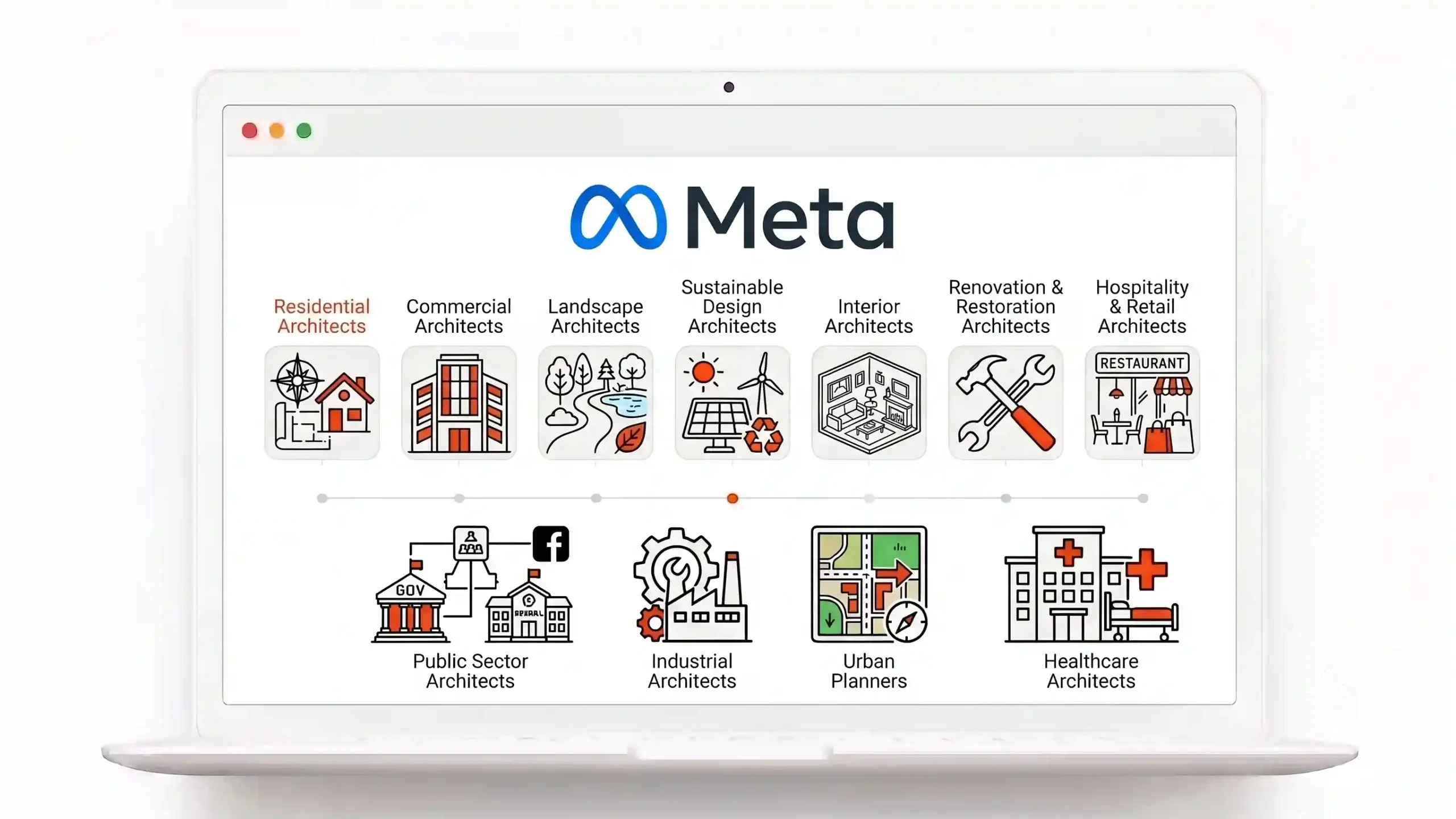
Quick Answer: Our Facebook Ads for Architects service is for architecture firms that want inbound project enquiries from people who are not yet actively searching, but would act the moment they see the right project.
We are the #1 Facebook Ads Company for Architects, and below are some of the types of firms we work with most.
Residential & Custom Home Architects

Homeowners are scrolling on Facebook and Instagram, and they stop when they see a home they like.
We put you in front of homeowners in your service area who fit that exact profile.
This is the strongest use of Facebook Ads for residential architects.
Commercial Architecture Firms

Developers and business owners research longer than homeowners. They also talk to more firms.
We use retargeting and case-study carousels here, so your firm stays on top of their mind when they’re making decisions.
Boutique & Studio Specialists

Heritage, Passivhaus, net-zero, or a distinct residential style needs a narrow, well-matched audience, not a broad one.
We build small, precise interest and lookalike audiences around that exact aesthetic.
Multi-Location or Regional Firms

Two offices means two geos, two creative proofs, one Pixel.
If you cover several cities, we structure campaigns by geography and service so budget is properly spent on areas that pay.
Weak locations are paused without touching the strong ones.
Landscape Architects

“Landscape architect” on Facebook pulls gardeners, hardscaping contractors, and people who want a weekend patio quote.
Our ads clearly say Licensed Landscape Architect, not “outdoor living,” and this difference filters a lot of junk.
Renovation & Remodel Architects

Our main Facebook marketing angle for this is before-and-after content, as it is one of the strongest-performing creatives on the whole platform for this kind of work.
We also use Facebook retargeting for architects here.
Developer & Multi-Family Architects

Developers are a small audience, and interest targeting wastes money here.
We build creative and landing pages around your portfolio scale, past project data, and credibility.
Institutional Architects (Schools, Healthcare, etc)

Paid social only plays a small, supporting role here.
We use it mainly for brand visibility, so your name is already familiar when a board member searches it.
Solo Practitioners & Small Studios

You do not need a large ad budget or a marketing team to start.
A focused $25 a day, aimed at right audience with right ads, can give a number of real enquiries a month, but in some cases, we do tell some architects to “Save 60 days, and then we’ll start with $40–$60/day.”
Larger Firms Building a Predictable Pipeline

When referrals and word of mouth aren’t enough, paid social for architects can become a predictable marketing channel.
Larger budgets let us test more creative faster and cover more of the audience worth reaching in your markets.
Interior Architecture & Design-Led Firms

Some clients want an architect who also handles interiors or a full design package.
We build creative that shows the full package, so that combined search lands on the right page.
Sustainable & Green Architecture Specialists

“Passive house designer” and “sustainable architecture firm” people already know what they want.
We chase these audiences using direct creative, tone, and funnels.
We’re a fit if you are:
- A licensed architect (or legally able to advertise as one)
- Able to answer enquiries ASAP
- Going to let us use real project photos
- Ready to fund enough ad spend to exit Meta’s learning phase
We’re NOT a fit if you are:
- Unwilling to handle calls and enquiries properly
- Expecting a signed $300,000 contract from someone’s first tap on an ad
- Selling architectural software, courses, or student services
- Hoping a $5-a-day budget produces 30 leads a week
- Only willing to boost posts and call it a campaign
If your specialty is not listed above, don’t worry. The method stays the same. Only the audiences, the creative, and the proof points change.
If you searched Facebook Ads agency for architects, Meta Ads for architects, Facebook Ads company for architects, Facebook marketing for architects, or Facebook Ads for architecture firms, you are in the right place. Same job. Different words architects use to search for us.
- Facebook Ads for Architects Results
Expected Results for Facebook Ads for Architects
Here is a realistic timeline for Facebook & Instagram Ads for Architecture Firms.
Timeline
Expected Results
Days 1–7
Everything from strategy call, Business Manager and Pixel/Conversions API setup to campaigns submitted for review
Days 7–21
Campaigns go live and are in Meta’s learning phase. Costs swing day to day here. That is normal. Early leads start to arrive.
Weeks 3-6
Ad sets with enough volume clear the learning phase. A clearer picture forms of which creative and audiences actually convert. Weak creative gets paused.
Weeks 6-12
Retargeting audience grows large enough. Cost per lead starts settling. Enough data is now collected to shift optimisation toward better-qualified leads.
Ongoing
Weekly creative refresh and budget optimization. Building and using Retargeting lists. Focusing on lowering CPL constantly.
Facebook Ads are fast to launch and slow to learn.
Meta’s algorithm needs conversions to find more of the same people. Architecture ads do not produce 400 purchases a week like a shoe store.
What “Results” actually mean
- Qualified calls and forms from people with a real project and a real budget
- Decreasing cost per qualified lead as creative and audiences improve
- Leads that match your actual project size
- Growing retargeting audience to keep your firm visible through a slow decision
- Booked consultations you can take to a fee proposal
What speeds up results
- You answer the phone and forms quickly
- The page matches what the ad promised
- Pixel + CAPI live before spending on ads
- You already have 15-20+ real, high-quality project photos or short clips we can use
- Reviews, licence, and portfolio are visible
- Ad spend is high enough to exit learning (often $30–$70+/day depending on competition)
- You always follow up after initial enquiry
What slows down results
- All traffic sent to the homepage
- Boosted posts instead of proper ad campaigns
- Slow lead follow-up
- A $10/day budget in a competitive metro
- No Pixel or Conversions API setup
- Using only stock photography
- No creative refresh for 90 days
- Optimizing for cheapest lead instead of best lead
- Using Advantage+
A single residential or commercial commission is easily worth four or five digits in fees. That is why a $100 qualified Facebook lead can still be cheap. You can do the math on your average fee.
Sorted ROI’s standard is to launch within 7 days when tracking, access, and creative assets are ready. Policy review can add time. A Housing false-flag can add more. That is why we always review policy in advance.
- Facebook Ads for Architects Pricing
Sorted ROI Facebook Ads for Architects Pricing
Quick answer: Sorted ROI’s management for Facebook Ads for architects starts at $699/mo + ad spend. Your ad spend is separate and paid directly to Meta. If architecture firms are in multiple locations, need a high number of campaigns, creative load, and ad spend level, then our exact price for a custom plan is quoted on the free strategy call.
Two options. Straight list. This is what you get.
Professional
$699
/Mo
+ Meta ad spend
What’s included?
Free Meta Ads account audit
Meta Business Manager setup (you own it)
Offer & Funnel (Architecture-specific)
Facebook + Instagram campaigns
Housing Special Ad Category/Policy review
Dedicated Landing Page & Lead Form
Conversion tracking (Meta Pixel, CAPI, & calls)
Ad copy and Creative Production
Geo-targeting and A/B Testing
Ad Fatigue & Creative Refresh Prevention
Weekly monitoring & Ongoing Optimization
Monthly report against enquiries and CPL
Month-to-month Contract
Advanced
Custom
Quote/Mo
+ Meta ad spend
Everything in Professional Plan, plus:
More campaigns and audience segments
Multi-office / multi-region targeting
Dedicated CRO
Advanced Retargeting Sequences
High-volume Creative Production (video, Reels, carousels)
Call tracking + offline conversion import
Multi-location budget split
Tighter lead-quality reporting
Pairing with Google Ads or SEO for a stronger marketing funnel
Full customization available
No lead sharing. No markup on Meta spend. No “guaranteed 10 projects in 1 month.” We do not sell numbers we cannot control.
Not sure which plan fits? Book a free appointment, and we’ll start with a free audit. We will say if Starter is enough or if you need a completely customized marketing strategy.
Why does your ad spend stay separate? Because if an agency charges a percentage of your ad spend, then the agency’s incentive is to spend more, not to spend smarter. So, a flat fee means our only incentive is to lower your cost per lead.
What should ad spend be? It should be at least $20–$60 per day for residential work in mid-to-large U.S. metros for at least 2 months. Below that, your ad account will be under Meta’s learning phase for another 2 months.
Problems We Fix As a Facebook Ads Agency for Architects
In our experience, the most common problems behind a Facebook Ads for architects search are a boosted post that produced likes instead of leads, cheap leads that went nowhere, nobody retargeted the people who already looked, and reported numbers that do not match reality. Sorted ROI’s Facebook Ads for Architecture Firms service fixes each one.
Below are some of the reasons architects search for [Facebook Ads for Architects] on Google. If one of these is yours, you need our help.
01
You Boosted a Post and Got Likes, Not Projects
What it feels like: You put $500 behind your best project photo using the “Boost Post” button. Comments and likes came in, but the phone never rang.
What is going on: Boosting is Meta’s simplest ad type, built for reach and engagement. It cannot run a real lead-generation objective, and gives you almost no control over who actually sees it.
What we do: Build real campaigns inside Meta Business Manager with a lead-generation objective, a lookalike audience built from real clients, and a pre-qualification form designed to filter out tire-kickers.
02
Your Leads Are Cheap, and Cheap Is the Problem
What it feels like: Cost per lead looks good on the report, but no leads have a real project or real budget.
What is going on: Broad, low-friction targeting and Meta’s automated Advantage+ features pull in students, other architects, and simply curious scrollers.
What we do: Add qualifying questions to every form, exclude irrelevant audiences, and treat lead quality, not just cost per lead, as the number we optimize toward.
03
Nobody Retargeted the Interested People
What it feels like: Someone spent four minutes scrolling your portfolio last week. You never saw them again.
What is going on: A lot of architecture decisions typically take 2-4 separate touchpoints over 30-90 days. A campaign built only to reach cold, new people gets just the first and coldest look, then lets that interest go cold.
What we do: Build custom audiences from portfolio visitors, video viewers, and form-starters, then keep new proof in front of them for the entire decision timeline.
04
Your Campaign Never Left the Learning Phase
What it feels like: Costs swing wildly week to week. “Learning Limited” sits permanently in your Ads Manager.
What is going on: Meta’s delivery system generally needs around 50 optimisation events within a 7-day window per ad set before results stabilise.
What we do: Optimise toward a realistic, higher-volume event first, consolidate ad sets instead of fragmenting your budget across too many, and only shift the target further down the funnel once real data supports it.
05
Your Ad Account & CRM Numbers Disagree
What it feels like: Ads Manager says you got 40 leads this month. Your inbox only shows 15.
What is going on: Apple’s App Tracking Transparency and Safari’s privacy settings block a large share of browser-only tracking, so a Pixel running alone misses real activity that genuinely happened, and Meta often overestimates that.
What we do: Install the Conversions API alongside the Meta Pixel, so only real, server-side lead events feed the numbers you see and the algorithm you are paying to learn from.
06
A Generic Agency Is Running Your Ads Like a Restaurant’s
What it feels like: Nice-looking carousels and a slowly growing follower count but still no signed projects.
What is going on: Someone trained on boosting restaurant specials and salon promos is applying that exact playbook to a $50,000 decision that unfolds over months, not minutes.
What we do: Build campaigns around the sales cycle architecture that actually has awareness, retargeting, and a form built to filter, not a template borrowed from businesses people buy from on impulse.
Two extra problems we see now and then
01 Advantage+ kept ON: Meta cannot find “people who hire architects” if it has never seen one. A brand-new account with zero conversion history hands Advantage+ nothing to learn from, and it just burns budget. So, we stay far away from Advantage+.
02 Creative Fatigue: The same three renders running for six months will tank your click-through rate over time. We build a pipeline of new creative before that ever happens.
Sorted ROI Do’s and Don’ts for Architecture Firms on Facebook Ads
Quick answer: Sorted ROI does the Facebook and Instagram Ads work that produces qualified architectural enquiries. We do not lock you in, mark up your ad spend, or report on likes as if they were leads.
We are not a generic social media agency running the same playbook for a boutique, a restaurant, and an architecture firm because architecture has a longer sales cycle, a far higher average client value, and a buyer who needs to see real proof before reaching out.
What We Do
- Build real campaigns around a lead-generation objective
- Install the Pixel and Conversions API before spending on ads
- Build retargeting for the full buyer’s decision cycle
- Keep the Meta Business Manager in your name
- Report in plain numbers: reach, cost per click, cost per lead
What We Don’t
- Guarantee a number of signed projects
- Take a cut of your fees or share leads with anyone else
- Optimise for form fills without a single qualifying question
- Hide our fee inside a marked-up media price
- Lock you into a 12-month contract
- Facebook Ads for Architects Process
How We Run Facebook Ads for Architects: Our Full Process
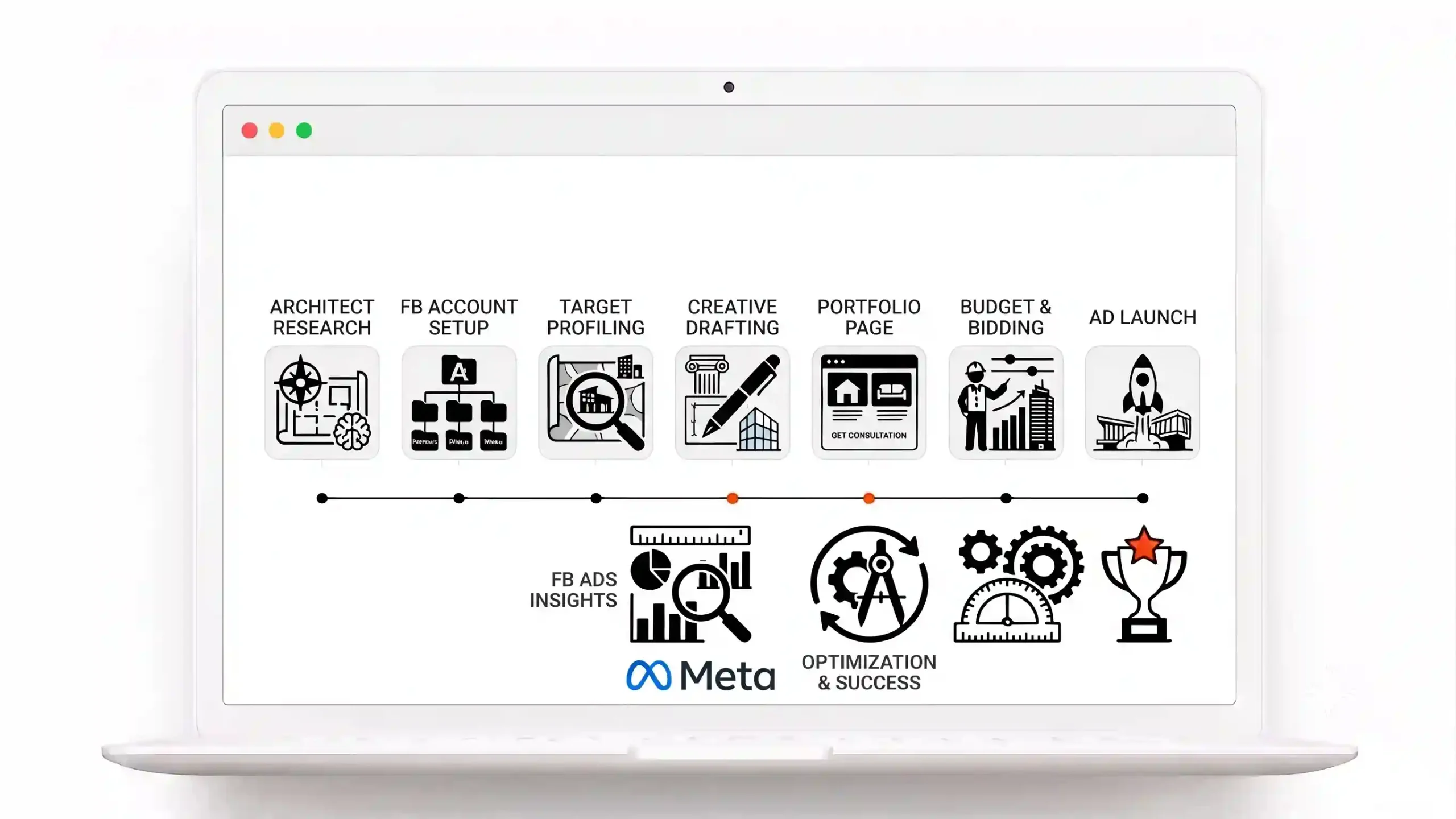
Quick answer: At Sorted ROI, we do not just “switch ads on.” Our process starts with a strategy call and a creative audit, then moves through tracking, audience building, campaign launch, and weekly optimisation. Nothing goes live before the Pixel and Conversions API are working, because everything after that is a guess without real tracking.
This is the full process. No mystery. No “secret algorithm” slide.
Foundations first. Then live ad spend and the audiences that convert.
Step 1: Free Strategy call (30 minutes)
You tell us the practice, the project types you want, the towns you serve, your fees, who handles the lead, who answers the phone, and what a good month looks like.
The most important question we ask is which project types you will refuse. That one answer writes half the targeting, half the form, and half the ad copy.
We tell you in plain language whether Facebook and Instagram Ads for Architects is the right lever for you or not.
If we cannot help you, we say so on this call, point you in the right direction, and part ways.
Step 2: Demand and Account Audit
If you already have a Page, Instagram account, or ad history, we use that. We do not start from zero. We use that account.
We review:
- Current Meta Ads account and analyse campaign types, audiences, creative, and results
- Page, Instagram, and Pixel status
- Who else is advertising architecture in your towns
- Your competitors’ live ads
- Your site’s conversion system
- Policy risk on housing-like creative
Next, we pull every architecture-adjacent ad currently running in your towns from the Meta Ad Library because an ad still running after 60 days is a strong signal it is actually working, not just being tested, and it tells us what your market already responds to.
The audit answers: which project types have real Facebook demand in your service area, which of those you want, and where competitors are sloppy.
Both of us get a plan on how to take things forward.
Step 3: Access and Ownership
Business Manager, ad account, Page, Instagram, Pixel; all yours.
Billing is yours, paid to Meta.
We work through admin access, and we leave you able to log in any day and see the same numbers we see.
Important: if your history lives inside someone else’s login, switching agencies later means starting from zero. We don’t let that happen.
Step 4: Offer, Funnel, and Creative Strategy
Before a single audience is built, we decide what each ad will say, based on who is actually seeing it.
We pick one primary offer per campaign:
- For cold audience: “See three homes we designed in [town]” / process guide/feasibility review
- For warm audience: Direct CTA ad to book a consultation
Residential ads do not share Facebook budget with commercial ones, and an additional ad does not share a page with a mixed-use pitch.
A cold audience has never heard of you, so for that, our ad sells curiosity (“See how we designed this”). A warm, retargeted audience already knows your work, so for that, our ad asks for the meeting directly. Using the same hard sell on both wastes the cold budget on people who are not ready for it.
For most architecture accounts, we start with a 70% prospecting + 30% retargeting split, then we move budget toward what produced better results.
Step 5: Audience Build
We group targeting into layers: interest and behavioral audiences, custom audiences built from your site visitors and engagers, and lookalike audiences once there is enough data.
We start with Geo first. Then custom audiences from your list and site. Then interest layers if we need them. Then exclusion lists.
Lookalikes wait until we have enough qualified events because a lookalike of junk leads produces junk leads.
Step 6: Campaign Architecture
We build campaign architecture in this structure:
Campaign (objective, daily budget, location) → Ad set (audience: cold/warm residential, cold/warm commercial, or retargeting) → Ad (one project type, one hook) → Page (proof for that particular ad promise).
Rules we actually run on:
- Conversion campaigns first. Capture the most interested people.
- One theme per ad set. Tight groups to help Meta learn quickly.
- Geo-targeting where you can take work. Exclude the 90-mile-away clicks you don’t want.
- Ad scheduling for when you or your team can answer or follow up quickly.
- Creative built for Feed 4:5 and Stories/Reels 9:16.
We would rather run three ad sets that each get fed real volume than twelve that all starve for budget because splitting your budget too thin across tiny audiences means none of them ever gathers enough data to perform well, so we deliberately keep the structure simple early on and only split further once there is proof it will pay for itself.
We stay away from Advantage+ campaigns from day one.
Step 7: Creative and Ad Copy
Vague Ad copy invites the wrong click.
A specific number beats a vague quality every time. “3,200 sq ft addition” earns a better click than “beautiful home addition,” because it lets the right person self-select before they even tap. We also test the project type as the literal first word of the headline, since that is usually what someone is scanning for.
For creative, we turn your project library into a real batch of ads: single image, before-and-after pairs, carousels, and short video cuts for Feed, Stories, and Reels.
In a carousel or a set of test images, we pair one wide “hero” shot with one tight, specific detail shot of the same project, like a stair rail or a light-filled reading nook. The wide shot sells scale. The close-up sells feeling. Together they outperform either one running alone.
Step 8: Landing Page Match
A homepage that sells every service has the worst conversion rate.
A “commercial architect” ad should never land on your residential portfolio. A “sustainable architecture” ad should never land on a generic commercial gallery.
So, Our Ad Promise = Our Page Promise.
We match:
- Headline = Ad promise
- First image = Project in the ad
- Proof = Licences, AIA, related project, reviews
- Form = Short, same qualification questions
Our landing pages:
- Repeat the project type from the ad
- Show a similar completed project
- Put the call and form buttons in the right places
We do not force a full site rebuild. We flag the minimum changes, but if the current site cannot convert, we optimise it before you spend money on it.
Step 9: Pixel and Conversions API Install
We install Meta Pixel, CAPI, call tracking, form events, and UTMs before a single ad goes live.
Every lead, call, and booking traces back to the exact campaign, ad, and audience that earned it.
We track:
- Clicks
- Pageviews
- Form fills
- Calls
- Booked consultation
We use a real inbound enquiry as the primary conversion. Page views and “clicks to portfolio” are secondary.
For lead pre-qualification, we use short form questions: project type, location, rough budget band.
We never skip them because they will save you hours from tire-kickers.
Step 10: Campaign Launch
We launch within the 7-day standard if access and assets are ready.
We start at a daily budget that can actually learn, with a daily cap so the entire month’s budget isn’t burned in three days.
The first few weeks are crucial. They are a creative and audience shift.
We:
- Pause ads that spend without qualified leads
- Scale ads that produced results
- Watch Account Quality for false housing or employment flags
- Watch and correct Geo leakage
- Add/Change form questions when a new junk lead pattern shows up
Step 11: Weekly Creative & Audience Optimization
Once real data exists, every week we:
- Check frequency on retargeting
- Push new creative into test
- Watch which project types actually convert
This is the work most architects do not have time for. It is also the work that makes the agency retainer worth it.
For frequency, we watch how many times the same person has seen the same ad. Once frequency crosses roughly 3-4 for a cold audience within a week or two, click-through rate predictably starts to drop. That is our signal to refresh the creative before performance actually falls.
Step 12: Budget Strategy
We move money to the campaign and the project type that produces qualified enquiries.
If residential ads convert and commercial don’t, residential gets more budget.
New architecture accounts rarely have enough conversions for full automated bidding on day one. So we start with a strategy that gathers clean data first and after getting a meaningful run of real enquiries, we give Meta more room for testing.
We do not “spread spend evenly so every service feels loved.” That is how average agencies stay average.
We also don’t fake conversion volume with irrelevant micro-events so the algorithm looks busy.
Step 13: Retargeting Activation
Architecture decisions take weeks. Retargeting keeps you in the buyer’s shortlist.
Once your custom audiences are large enough to target meaningfully, we turn on a proper retargeting sequence, built for the 2-4 touchpoints over 30-90 days for a typical architecture decision cycle.
Retargeting lists we build and use: service-page visitors, form starters, video viewers, meaningful time on site, Instagram engagers.
We run case studies, testimonials, process, and a direct “book the call” ad for that cycle.
We sequence retargeting by behaviour, and not just repeat the same ad over and over.
Someone who watched most of a video sees your next-strongest project. Someone who visited the contact page sees a direct “ready to talk” ad.
Same audience pool, different message, matched to how warm they already are.
Retargeting is a support system, not a substitute for prospecting because architecture’s long cycle is an advantage if you stay present without being annoying.
Step 14: Monthly Report
Monthly report you can read:
- Spend
- Reach
- Enquiries (calls + forms + bookings)
- Cost per lead
- Cost per enquiry
- What we changed
- What we’ll test next
What we still need from you
- Access to Business Manager and the website
- Share new project photos and video as work finishes
- Clear yes/no on project types and minimums
- Answer new enquiries as fast as realistically possible
- Honest notes on which leads were real
- Tell us about new specialties or service areas as you expand
- Do not edit live campaigns without telling us first
Useful FAQs about Facebook Ads for Architects
It is paid advertising on Facebook and Instagram built for architecture firms. You pay Meta to put your projects, proof, and offer in front of people in your service area who look like the clients you already want. Actual process is not boosting a post. It is not buying likes. It is a lead system that brings new projects and money.
Yes, when it is built around a real offer, real creative, qualification, and proper tracking. It works best as demand creation and retargeting, especially for residential and design-led work.
Google Ads catch people already typing “residential architect near [city].” Facebook Ads reach people who are not searching yet but have shown several patterns of interest for the same services. Facebook is best for visual discovery and retargeting.
Sorted ROI’s Facebook Ads for architects plan starts at $699 a month + ad spend depending on campaign count, locations, and management load. Ad spend range: For testing FB ads for architects, we start with $20–$70/day for 2 months. Your ad spend is separate and paid directly to Meta.
For qualified architecture enquiries, a working range in the market is roughly $40–$150+ depending on city, project type, and your lead qualification criteria.
Clicks as soon as ads are live. First enquiries come in 10–21 days and a stable picture on which creative and which project type to scale is clear in 4–8 weeks. But more stable results show after 6-8 weeks of consistent ad spend, clean data, then we scale what works.
Yes. A page that matches the ad improves conversion rate. We always build one landing page per project type. Sometimes we also start with a strong existing service page but never with the homepage.
Yes, we can work with your existing Meta Ads account. We audit, keep what works, rebuild what wastes money. Your account history stays. You do not lose the account.
Usually no, if you are advertising architectural services only but if your ad looks like a home for sale, Meta can treat it as housing ad and then targeting locks or ads get rejected. We review this before launch. Generalist agencies often learn it the expensive way.
Your best finished-project photos and videos. Any walkthrough or drone footage. A few real reviews and testimonials. If you have none, we do have a way around it.
Yes but Facebook Ads for commercial architects need a heavier retargeting and lookalike mix than residential campaigns. Ads to target people who already hit your commercial project pages, plus lookalikes of past commercial clients.
We specialise in small and local service businesses. Architecture is one of our strongest verticals. We also run the core Meta Ads and Google Ads services.
You own the account. We work on month-to-month basis. You can pause campaigns anytime. Keep your data and all the assets we built.
No. Nobody can guarantee. In fact, stay away from the ones that offer guarantee. What we can guarantee is a strong process, tracking you can see, and transparent reporting on everything we did.
You can DIY if you have time. Most architects don’t. A healthy architecture ad account needs weekly creative decisions, frequency control, qualification tweaks, and tracking. That is time you should spend on drawings and clients.
- Next Step
Ready to Turn Facebook & Instagram into Architecture Project Enquiries?
Tell us about your firm, and we’ll get back to you with complete details about what’s currently working best in your industry and what we can do to grow your business.
Take the initiative.
Affordable Pricing. Flexible Agreements. You own the data.